Tag Archives: comic books

Use My Voice | The Revolution of Cassandra | Eric D. Howell

Cassandra is on the rise. Viva la Revolution!

The Revolution of Cassandra

Go check out The Revolution of Cassandra for an unusual new work in comics. Here is a quirky story covering some serious subject matter. It reminds you of the fundamental need of making your voice heard. We can take that too much for granted in the United States. Just imagine what it’s like in parts of the world where the government is actively involved in keeping its citizens docile. Filmmaker Eric D. Howell is a fascinating storyteller dude–just the sort of creative person to lead the way with this audacious graphic novel, with Hollywood flair. Howell got into the entertainment business as a stuntman and, through determination, has risen up the ranks to movie director. You may know him from the 2017 Emilia Clarke movie, Voice from the Stone. By any measure, Howell’s career path is an impressive one.

USE MY VOICE by Amy Lee of Evanescence

Enter The Revolution of Cassandra, Howell’s new tale of adventure and idealism about two very different sisters, Moira and Cassie, and how they stumble into a civil war and perhaps lead a revolution. As I say, Howell’s new graphic novel has a very cool Hollywood connection. For starters, Howell is a well-liked and well-connected person. One of his friends is a very cool musician you may know. The Revolution of Cassandra served as an inspiration for Howell’s friend and Grammy Award-winning musician, Amy Lee of Evanescence, as she was writing her band’s new song, “Use My Voice.” The song’s video, directed by Howell, has been viewed more than two million times on YouTube since its premiere in late August.

Cassandra’s toes know the earth.

A few more words about this graphic novel. If you’re looking for an immersive work with a true cinematic look and feel, then The Revolution of Cassandra is for you. It is a mature work in the sense that adults will enjoy it for its more adult and sophisticated sensibility. It’s not for kids, per se. Let’s go with teens and up. This is set, after all, in a very gritty backdrop. There are rough men wandering about who are prone to pushing around women, if they can. That is, unless they’re confronting Moira and Cassie. Overall, there’s an earthy and authentic vibe running through. Moira is more reckless. Cassie is more the Earth Mother with her bare feet, or in Birkenstocks, solemnly gauging the environment.

The Revolution of Cassandra

Now, imagine attempting to stand out at a truly significant comics convention, like Comic Con in San Diego. Well, this is where brand sharing helps. Howell has partnered with Republic Restoratives Distillery and Craft Cocktail Bar in Washington, D.C. to introduce Purpose Rye. Purpose is the first single barrel expression from Republic Restoratives Distillery and is a limited run of only 100 barrels. This 95% rye mash bill has been aged in American oak for nearly five years, imparting rich notes of caramel, spice, hints of smoke and cocoa nibs. Every bottle of Purpose Rye sends a donation directly to Fair Fight Action which protects free and fair elections around the country. Purpose Rye is available for order online via Schneider’s of Capitol Hill in Washington, D.C. Twin Cities bartenders will be mixing Cassandra inspired cocktails this month to inspire customers to use their voice” to support the social causes that matter to them. For Cassandra cocktail recipes, follow @revolutionofcassandra on Instagram.

Under the right circumstances, and responsibly, alcohol and comics do mix.

It was a lot of fun chatting with Howell and you can check out our conversation by clicking below:

The first chapter of The Revolution of Cassandra is available now for you to view for free.

Eric D. Howell, storyteller

2 Comments

Filed under Comics, Graphic Novel Reviews, Interviews

‘George’s Run: A Writer’s Journey Through the Twilight Zone’ Now on ComiXology

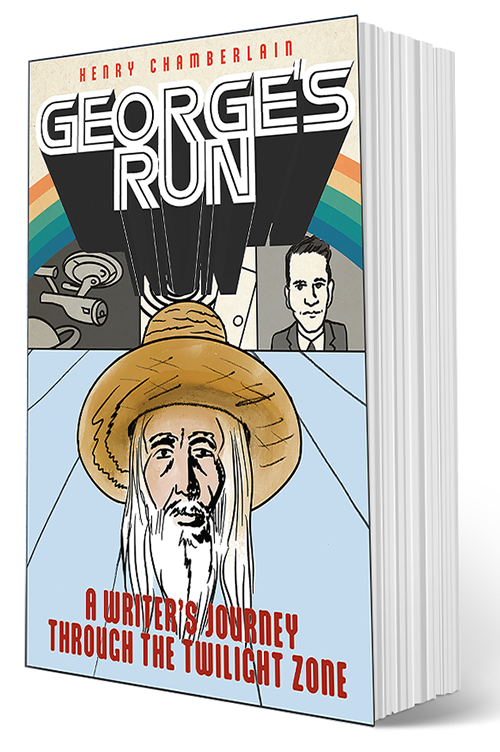
GEORGE’S RUN by Henry Chamberlain

GEORGE’S RUN is now ready for your digital reading pleasure at comiXology. Just follow the link right here. And now, for those unfamiliar with this graphic novel, here are a few words. And, for those loyal true believers who know what I’m talking about, I hope you get to enjoy the book. A print run is coming soon too. This is a book about a bunch of hungry writers all seeking that elusive touch of strange!

Charles Beaumont on the set of “The Howling Man.” Illustration by Henry Chamberlain

Imagine a book that checks off all the boxes: compelling main character, appealing to any age, and a meaningful story. This is a graphic novel about the life and times of George Clayton Johnson. You don’t need to know who he is. But you won’t forget him once you do. George is a gateway to a universe of storytelling. George came from nothing but went on to claim his rightful place among the Rat Pack of Science Fiction, in the heyday of a lot of creative energy, with icons like Rod Serling and Ray Bradbury.

George Clayton Johnson’s Cafe Frankenstein

I encourage you to look up professor Paul Buhle because he provided an essay for my book that really blows my mind! Mr. Buhle is a respected scholar who has worked with various cartoonists over the years. I have also received a testimonial from novelist Jerome Charyn, who you may be familiar with. I have received a testimonial from cartoonist Jeff Smith and cartoonist Craig Frank. I have received a testimonial from Disney writer Martin Olson. A lot of very cool and significant folks have given GEORGE’S RUN a thumb’s up. This is one of those books that is very special, I think, and part of the magic is that it’s offbeat and unusual. At the heart of the activities going on in this book are all the interconnections emanating from the original Twilight Zone. It’s like a mystery within a mystery. It’s like a favorite amusement park ride. I’m looking for an agent who, once she’s read the book, is thrilled by it and can’t wait to let people know about it.

George Clayton Johnson

George is like a Holy Grail of Insight who, Henry, the author of this book, seeks. Henry finds George and unlocks an enigma wrapped in a riddle. So much hiding in plain sight. Within a quirky and dream-like narrative, George and Henry embark upon an adventure in grand storytelling. In the process, the reader becomes immersed in fanciful and insightful observations recollected.

George’s Run: A Writer’s Journey Through The Twilight Zone is NOW available on @comiXology Submit!

Leave a comment

Filed under Comics, Comixology, George Clayton Johnson, Sci-Fi

Interview: Peter Bagge and a Whole World of HATE

Harvey Kurtzman is a god. Of course, you can’t please everyone. Panel excerpt from HATE by Peter Bagge, 1991.

Comedy is not pretty. Isn’t that what Steve Martin concluded oh so many years ago? Well, it’s true. If humor has anything to do with revealing the truth, then it’s gonna get ugly. Harvey Kurtzman knew something about this too and was revered by other cartoonists moving up the ranks, like Peter Bagge. And, if you study Peter Bagge’s work, you’ll see the Kurtzman influence, sometimes subtle and sometimes in a direct reference.

From “What’s in a Name?” Written by Peter Bagge. Drawn by Danny Hellman.

A sample of Harvey Kurtzman: Mad #4, 1953

One of the darkest and most hilarious bit of comics I’ve read is a collaboration between Bagge as writer and Danny Hellman as illustrator. The piece is about a meeting between young aspiring cartoonist Peter Bagge and the legendary cartoonist Harvey Kurtzman. With a cutting New York sense of humor, Kurtzman is brutally depicted as a bitter doddering old man. The punchline, as it were, states that Kurtzman’s erratic behavior may have been caused by the fact he was dying from cancer; and he did indeed die not long after this infamous meeting!

Ah, and then there’s the R. Crumb influence–and that certainly makes sense, if you know anything about Peter Bagge’s work. My goal in this interview was simply to explore the process with a masterful cartoonist and hopefully end up having asked the right questions. I think what really stands out for me from our conversation is that Bagge’s outlook is that of a highly irreverent individual, as well as a sensitive and thoughtful person. So, basically, Bagge possesses a sensible mix of character traits that most of us can relate to. That is part of the magic of Hate’s main character. Everyone can relate to something about Buddy Bradley, the guy who wants to get along, but not too much!

A sample of Peter Bagge: Hate #16, 1994.

Well, that gives you an idea of Bagge’s offbeat sense of humor. Comedy, the very best and most cutting, is definitely not pretty. And so it was my goal to explore this subject with Bagge, and many other related matters! I hope you enjoy the video interview, which you can access by clicking to it down below. Peter Bagge’s work is most definitely adult fare and in the best spirit of the term. It is dark, sophisticated, and meant to elicit a world-weary cackle of recognition. Enjoy!

The Complete Hate from Fantagraphics is available November 24, 2020. Book One (HATE 1-15) focuses on young Buddy Bradley’s travails in early 1990s Seattle. Book Two (HATE 16-30) focuses on Buddy and his girlfriend Lisa Leavenworth’s move back to Buddy’s native New Jersey (and a switch from black-and-white to full color). Book Three (HATE Annuals 1-9) features the final arc of Bagge’s magnum opus, as Buddy and Lisa become parents (and buy a garbage dump). Each volume, along with the slipcase, contains new covers, endpapers, title pages, and other surprises by Bagge.

For more details, visit Fantagraphics right here.

Leave a comment

Filed under Comics, Fantagraphics, Interviews, Peter Bagge

Review: SPELLBOUND by Bishakh Som

Spellbound by Bishakh Som

Spellbound by Bishakh Som. Street Noise Books. New York. 160pp, $18.99.

Graphic memoir is my speciality and I completely embrace the new graphic memoir, Spellbound, by Bishakh Som. What a wonderful book. It’s fun, inspiring and insightful in so many ways. This is the kind of work that I enjoy creating and the kind of work that gains my attention the most. This is work by an auteur cartoonist who welcomes the reader into an inner life, ultimately dropping the veil: engaging, revealing, and sharing. This is an intricate act of self-expression which the reader follows usually without any expectations on how it all turns out. What the cartoonist has to say and how the story is told becomes as important as anything else. In this case, Bishakh Som has a theme we’ve all been reading more and more about, issues of gender fluidity; and this story is inextricably linked to a personal journey, a celebration of the self and self-expression.

Anjali became a way of sorting through issues and showing the world one’s true self.

But before one stands before the world naked, a veil of sorts can help with the process. This is part of what I believe led Som to create an alter ego. As Som proceeded upon his transition from male to female, I can see where he found it a source of comfort and insight to have his female alter ego grace the page. Thus, Som created comics that feature the character of Anjali who became a way of sorting through issues but, even more important, a way of showing the world the true self.

“I’ve always been this way.”

Our story begins with Anjali quitting her job and setting off on a new adventure. This is much like Som’s own story of quitting a focused career in architecture in order to make room for a life in the graphic arts, specifically creating graphic novels. Anjali has embarked upon uncharted waters but doesn’t seem too phased. At first, the biggest challenge seems to be just keeping her cat, Ampersand, at bay. The artwork is very crisp and engaging and certainly meets the biggest demands placed upon comics: clarity and entertainment. Anjali is the perfect metaphor for the determined soul who will not be beaten down by challenging circumstances.

Anjali relaxing and having fun.

When Anjali stumbles upon a family photo album, this triggers countless memories which take her back to growing up in Ethiopia. Anjali’s parents were born in India, both of them intellectuals working for the UN. Over the course of Anjali’s first six years, she grew as fond of Ethiopian culture as she did of American pop culture. When revolution broke out, Anjali’s parents resettled in New York. This led to Anjali going to the United Nations International School and destined to a most urban and erudite life.

One generation gives way to the next.

Over the course of this graphic novel, the reader is immersed in Anjali’s journey: a life rich in exploration and searching, one that beautifully mirrors the life of Bishakh Som. It is a life we see from various vantage points, from the banal and quotidian to moments of insight and epiphany. For instance, Anjali must come to terms with her demanding and conservative parents. In the end, she is witness to their decline and, from that, she gains some wisdom. And she continues to grow with the help of some friends.  For someone who prefers to avoid people, Anjali seems to find her best moments when she is around someone else. It is a lesson that Bishakh Som learned from well.

Spellbound is published by Street Noise Books. For more details, visit here.


4 Comments

Filed under Alternative Comics, Auteur Cartoonist, Comics, Graphic Novel Reviews

Interview: François Vigneault and TITAN

François Vigneault

Here is an interview with cartoonist, illustrator and designer François Vigneault. We chat about his graphic novel, TITAN, and related matters. The French edition of TITAN was nominated for multiple awards including the Prix des Libraires and the Joe Shuster Award, and now we finally have the English edition published by Oni Press and available as of November 10, 2020.

TITAN by François Vigneault

TITAN, a graphic novel set during a worker’s revolt has, like any good science fiction, a “torn from the headlines” relevance to it. Politics and protest are clearly on the forefront now. In the U.S., we have one of the most consequential presidential elections in history. It will be a brave new world, on so many levels, that we will all enter into later this year. So, an intriguing sci-fi thriller graphic novel will definitely fit right in. For this interview, I ask François about the book and, specifically about the two lovers caught in the middle. We also discuss the whole process of creating comics, moving up the ranks as an independent cartoonist, and the life of an artist in Montreal, Quebec.

Hope you enjoy the video interview. Here is some additional material exclusive to this post:

What authors did you turn to for guidance or inspiration for TITAN?
There were definitely a big mix of influences and inspirations over the years, but I will mention a few that pop out to me:
Grendel Tales: Devils and Deaths by Darko Macan and the late Edvin Biuković is a comic I first read as a teenager and it had a big influence on me, like TITAN it is a story of love during wartime and I think anyone who enjoys my book will appreciate this somewhat underrated gem… Biuković’s untimely death was a real loss to the world of comics.
Italo Calvino is one of my favorite authors; most of his work is very, very different from what I am doing, but one of my favorite volumes by him is Difficult Loves, which includes a range of tales ranging from “Wartime Stories” to “Stories of Love and Loneliness” which definitely had an influence on TITAN. I know I reread that book at least twice during the creation of TITAN.
Finally, I think probably the biggest influence on me for the last decade or so has been the late, great Ursula K. LeGuin; she somehow manages to surprise me again and again over the years. Every time I think I have her figured out, or know what to expect from her, she throws another curveball (or perhaps a right hook is a more appropriate metaphor) and I’m left pleasantly dazed by the experience. The singular way that LeGuin would mix interpersonal pain with cultural conflict has been and remains a tremendous influence on my work. I had the privilege of meeting her very briefly back when I lived in Portland, and I am so glad that I had that opportunity, even if all I did was gush about her work and get my ratty old copies of Earthsea signed.
What would you like to share about the writing, the subtext, to TITAN?
That question is very open to interpretation! So I’ll just briefly say that despite the many dark elements to the plot, the corruption, violence, and inequality that is present throughout the book, I do think that TITAN is ultimately a hopeful story, a story about the capacity of human beings to connect with each other.
How do you think TITAN mirrors our society today and what is timeless in your work?
I do think so, though I will leave it to others to decide if the mirror that TITAN holds up to our world is interesting, useful, or just plain boring. Definitely the book is very much inspired by our world, and sometimes feels eerily prescient in how very closely it maps to events that are unfolding right now (keep in mind I finished writing TITAN back in 2017), it is disturbing, to tell the truth. ButI suppose that shows that some of TITAN’s themes of injustice, state-sanctioned violence, and the cruel indifference of capitalism to human suffering are certain to be with us for a long, long time. But as I mentioned earlier, there is also a theme of connection, love, and reconciliation that is present in the book as well, and I hope that those ideas are timeless as well.

Be sure to visit François Vigneault at his website right here.

Excerpt panels from TITAN

8 Comments

Filed under Comics, Interviews, Oni Press

Will EISNER art show – ‘A Contract With God’ at Comic Art Factory (Oct 15-31, 2020)

Work from A Contract with God

Will Eisner is such a unique cartoonist with a determined spirit and an unwavering vision. You could say he’s the gold standard when it comes to the tradition of the auteur cartoonist, the artist-writer who creates singular works in comics, specifically graphic novels. In the special case of Mr. Eisner, he arguably created what we now know as the graphic novel, at least in North America. Undoubtedly, his 1978 graphic novel, A Contract with God, caused quite a stir in the creative community and, most significantly, crossed over into the general public. With that in mind, it is notable to have any art show that displays original work from this landmark book. Comic Art Factory will exhibit a selection of pages (tight pencilled prelims and inked pages) that have never been exhibited nor offered for sale.

Excerpt from A Contract with God

The exhibition will take place from the 15th until the 31th of October at the Comic Art Factory gallery, based in Brussels, Belgium. Over 60 pieces will be available for sale at the gallery and through the website.

Excerpt from A Contract with God

Excerpt from A Contract with God

If there is one person who can speak to what is great about Will Eisner, it is Denis Kitchen, who published all of Will Eisner’s graphic novels. You can listen and view my recent interview with Kitchen right here. Kitchen got to know Will Eisner very well and freely admits that it was Eisner who led the way on the future of graphic novels. As far back as the 1940s, Eisner envisioned the future of long form comics collected in book form. Eisner’s long-running comic strip, The Spirit (beginning in 1940), which went on to be collected into books, indicates what lay ahead for Eisner.

Comic Art Factory is a leading gallery in comics art. Frederic Lorge is the manager of the Comic Art Factory gallery. Denis Kitchen is a long-time publisher of Will Eisner and an art agent, handling art sales of such leading artists as Will Eisner and Harvey Kurtzman through his company Denis Kitchen Art Agency. All images are ©Will Eisner Studios Inc.

8 Comments

Filed under Art, Comics, Will Eisner

Wisconsin Funnies | Underground Comics | Alternative Press

The Bugle alternative weekly, circa 1975.

Interview with Denis Kitchen and James P. Danky

Get your own copy of the Wisconsin Funnies: Fifty Years of Comics exhibition catalogue. This fully illustrated 244-page catalogue features more than 150 comic illustrations by thirty-one renowned comic artists. Available at the MOWA Shop in West Bend, MOWA | DTN inside Saint Kate—The Arts Hotel or online right here.

Excerpt from Lynda Barry

The comics discussion continues. This time around I interview Denis Kitchen and James P. Danky, co-curators of the comics art show, Wisconsin Funnies: 50 Years of Comics, at the Museum of Wisconsin Art (MOWA), on view through January 10, 2021.  Of course, comics is an art form but we’re arguably still moving beyond old prejudice and misunderstanding. A show like Wisconsin Funnies helps to provide context and history in the study of comics. For example, while an underground comics are often associated with San Francisco, popularized by such leading figures as R. Crumb, a rich history of independent comics activity can be found in the midwest, specifically Wisconsin. Today, that hub of comics energy continues to percolate, led by such notable figures as Lynda Barry, winner of the the prestigious MacArthur Genius Foundation fellowship and an an associate professor of interdisciplinary creativity in the art department at the University of Wisconsin-Madison.

Kings in Disguise, a graphic novel published by Kitchen Sink Press, by Dan Burr and James Vance.

During the course of our conversation, we touched on the unique difficulties that may arise in mounting a comics art show in a museum. I specifically suggested that Wisconsin Funnies could become a traveling show. That is actually an idea that has a history behind it. Both Danky and Kitchen, while certainly happy to indulge such an idea for this show, tend to think the focus is too regional. What would stop a curator in another state from favoring their own state over a showcase of Wisconsin comics? That said, Wisconsin natives Danky and Kitchen have led the way in putting together a most compelling show and set the bar high. You also have to factor in that a lot of the power and strength about this show is due to the fact it is made possible in large part by Denis Kitchen, a huge figure in comics. I factor in all the contributions that Denis Kitchen has made: his own comics, writing, journalism, publishing and promotion, his founding Kitchen Sink Press, the Comic Book Legal Defense Fund; and his work with so many leading figures in the business, including Will Eisner, Harvey Kurtzman, Will Elder, Scott McCloud, Stan Lee, and Alan Moore. It all adds up. Right alongside Kitchen is James P. Danky, a respected historian and authority on the alternative press. It was a pleasure to talk with both of these men. I also want to add to the credits for this show: associate curator J. Tyler Friedman and guest curator Paul Buhle.

Group Self-Portrait of the core group of midwestern cartoonists, circa 1971: Denis Kitchen, Don Glassford, Jay Lynch, Jim Mitchell, Wendel Pugh, Bruce Walthers, Skip Williamson.

Any worthwhile endeavor like a major art show is made up of many unique individuals. The story of this art show is the story of numerous high-spirited and hard-working artists. One of the highlights to this interview was getting a chance to explore the inner lives of these cartoonists by using a group self-portrait as a starting point. I am referring to the above work. Here you find the core group of cartoonists who Denis worked with: Don Glassford, Jay Lynch, Jim Mitchell, Wendel Pugh, Bruce Walthers, Skip Williamson. Some went on to professional careers while others moved in other directions. But, in that special moment in time, they were all making a little bit of history. Maybe they were too busy to ever acknowledge it at the time. That’s okay. The art is now on the walls and can speak for itself.

MOWA can be proud to have a show that celebrates Wisconsin’s rich and varied comics tradition. You will find a broad spectrum of content here, including underground comics, editorial cartoons, graphic novels, and even the state’s own superhero comic, Badger, by Jeff Butler!

Denis Kitchen, Henry Chamberlain, James P. Danky in conversation.

Get your own copy of the Wisconsin Funnies: Fifty Years of Comics exhibition catalogue. This fully illustrated 244-page catalogue features more than 150 comic illustrations by thirty-one renowned comic artists. Available at the MOWA Shop in West Bend, MOWA | DTN inside Saint Kate—The Arts Hotel or online right here.

Leave a comment

Filed under Alternative Comics, Comics, Comics Scholarship, Counterculture, Interviews, Museums

Interview: Barbara Slate and a Career in Comics and Graphic Novels

Barbara Slate self-portrait

Barbara Slate spent twelve-hour days working on The Mueller Report Graphic Novel in order to get it out in a timely manner. In fact, her book got mentioned by a Republican representative during the Trump impeachment hearings in the House of the U.S. Congress. Trump went on to be impeached by the House. But there’s more to Barbara Slate. Here is an in depth look at a wonderful career in comics and graphic novels. Barbara Slate is known for being a pioneer in feminist comics. Her first big break came with her character, Ms. Liz, which began on greeting cards (selling over two million), then a comic strip, and even an animated short on NBC’s Today Show! What an honor. And, as I suggest, there is much more like writing for DC Comics, Marvel Comics, Harvey Comics and Archie Comics. Among her many accomplishments in the visual storytelling biz, I was intrigued with the fact that she wrote 150 Betty and Veronica stories for Archie Comics! We cover that in this interview! Barbara was always fascinated with the friendship between these two young women who were so different. And, by the way, what the heck did they see in Archie in the first place? Good question.

Barbara Slate lecture poster

So, as always, I share with you about my own journey to better understand and appreciate the comics medium. I do it by sharing of my own work and by reviewing as much material as I can. And, of course, I do it by putting together special interviews such as this. You can say that I do my best to find a different angle to the people and subjects I choose to focus on. And I have no intention of stopping anytime soon. Not when I have creators like Barbara Slate to help guide the way.

The Mueller Report Graphic Novel by Barbara Slate

Now, a few words on the two recent titles that we feature in this interview. First, let’s cover The Mueller Report Graphic Novel. And then we’ll take a look at You Can Do A Graphic Novel. First off, I think Barbara has definitely created one of those books that becomes a keepsake. I am constantly culling through my books but this one is a keeper. And why? Well, within its 107 pages, it masterfully makes sense of one mammoth of a book that deserves close attention. The actual Mueller Report, a text-dense book clocking in at nearly 500 pages along with supplementary material, lays out how Russian interference has wreaked havoc upon our electoral process as well as provides a jaw-drawing look at how the Trump team, with Trump himself very much involved, have obstructed justice. A stream-lined concise graphic novel actually makes sense–and this is it! This book is, no matter what the subject, a perfect example of how to condense a complex subject into a compelling read.

Page from The Mueller Report Graphic Novel by Barbara Slate

Barbara Slate has the magic touch with bringing the essential facts in better focus. The reader gets to know all the players and what they did. The often Byzantine-like world of Russian oligarchs is treated in a straightforward manner. A con game that no one was expected to be interested in or even be able to follow is made accessible. As we’ve heard many times over, it was not Robert Mueller’s place to determine if the President of the United States, no matter who they are, should be impeached. It is up to Congress. As we all know, Congress took a very different path than would have been expected on their way to impeachment. The Democrats had the compelling case all along with the Mueller Report but they chose to focus on Ukraine. That said, the Meuller Report is still with us, many portions of which await removal of redactions and future days in court. This graphic novel remains a handy guide for when the chickens come home to roost.

You Can Do A Graphic Novel by Barbara Slate

If you’re looking for a wonderful instruction manual on comics, then you’re all set with Barbara’s You Can Do A Graphic Novel. This book will guide you through the process of telling your story through comics. You can aim for doing a full-length graphic novel in the long run. But, to begin with, you can follow these easy-to-follow steps and learn all the components to storytelling. This 232-page, fully illustrated, book will delight newcomers and even more experienced cartoonists because you have Barbara Slate sharing techniques and industry insight from a long and successful career.

Pages from You Can Do A Graphic Novel

As I say, even more experienced cartoonists will welcome the easygoing and highly informative format. Yes, you too can learn how to properly plot a comics script. Barbara Slate learned from the best. When she first started at DC Comics, she was taught the color-coded plotting system by none other than Paul Levitz, one of the biggest names at DC Comics. The book is perfect for all ages, and it will specifically appeal to young people just starting out.

Barbara Slate is one of the best. Check out her website to learn more about her work and her online comics courses. Visit Barbara Slate right here.

Leave a comment

Filed under Comics, graphic novels, Interviews, Visual Storytelling

Comics Studies: WISCONSIN FUNNIES at Museum of Wisconsin Art (MOWA)

WISCONSIN FUNNIES at Museum of Wisconsin Art (MOWA)

Wisconsin Funnies. Catalogue edited by Terry Ann R. Neff. Exhibit co-curated by James P. Danky, J Tyler Friedman, and Denis Kitchen with contributions by Paul Buhle. Museum of Wisconsin Art. 2020, 248pp.

Get your own copy of the Wisconsin Funnies: Fifty Years of Comics exhibition catalogue. This fully illustrated 244-page catalogue features more than 150 comic illustrations by thirty-one renowned comic artists. Available at the MOWA Shop in West Bend, MOWA | DTN inside Saint Kate—The Arts Hotel or online right here.

The Real vs. The Ideal, ink on bristol, by Lynda Barry, 1989.

I have nursed a habit, that became a way of life, that became a saving grace. Specifically, for the purposes of this post, I am referring to my own lifelong work in the comics medium. Being a cartoonist really is something very special. It is something so special that all sorts of interested parties want to be part of the magic and that includes all sorts of academic types, galleries and museums. That is all to the good. Comics is still a relatively young medium in some respects so anything that spreads the word can’t be all that bad, right? Comics is an art form, owing so much to countless American contributions and around as far back as there’s been a United States, only now getting the sort of recognition it deserved all along. We can’t, nor should we, include every single shred of work ever made but we have a great bounty of examples to hold up as bona fide works of significance and value. The art show currently on view at MOWA (extended to January 9, 2021) is another step forward. Let’s take a close look at the museum catalogue.

Frank O. King’s Gasoline Alley, page from 1922.

It takes a historian’s perspective to look at Wisconsin and explain all the comics activity there as having a lot to do with Chicago. Well, it’s true. A hundred years ago, Chicago was a home for newspaper empires with a high demand for cartoonists. This is made abundantly clear in Paul Buhle’s essay to this catalog. If a young cartoonist wanted to make it big, a very good place to hone their talent would be in nearby Wisconsin. Keeping to a historian’s long view, we come to understand that comics got baked into Wisconsin bohemian culture. By the 1960s, it was so much a part of the local art scene’s DNA to make you think you were sipping wine and munching on croissants in Paris, where they embraced comics, the Ninth Art, with great fervor as opposed to your average American, especially a corn-fed citizen right in the heart of farms and honest working folk. All sorts of factors simply added up over time. For one thing, never underestimate a cartoonist’s need for peace and quiet. A more methodical pace can lead to a more cerebral and productive life. Wisconsin native Frank O. King, who made the big move to Chicago, showed the way with his deceptively simple comic strip honoring Americana, a comic strip which was also amazingly innovative, Gasoline Alley, which debuted in the Chicago Tribune in 1918. Take a look at the example above and you might see how this highly stylized format would have influenced another master of comics, Chris Ware. Along with King’s trailblazing work, add Sidney Smith (The Gumps), Claire Briggs (Casper Milquetoast), and Carl Anderson (Henry). For an in depth look, read Paul Buhle’s Comics in Wisconsin.

From Denis Kitchen, Star Reporter, 1972.

When you consider what gives a certain place its character, you must think about its guiding forces. One such consequential force of nature in Wisconsin is Denis Kitchen. This is the story of an enterprising young cartoonist who bought some farmland in Wisconsin and converted the barn into a comics studio. From here emerged Kitchen Sink Press, the legendary comics publisher. In 1973, Kitchen joined the back-to-the-land movement and converted a barn in Princeton, Wisconsin and all sorts of comics emerged, underground and mainstream alike. Kitchen was in a position to continue to grow as an artist himself as well as publish the work of other artists and help them out when he could.

From Buddha Crackers by Michael Newhall, 1977.

Michael Newhall, one of the indie cartoonists in the area, rented a space at the Kitchen barn for $50 a month or, given that he was perpetually cash-poor, would pay Kitchen with a work of art each month. While Kitchen would be the first to joke around about whether there truly existed an underground movement or if it was all just a bunch of hype, there was no doubt that numerous like-minded souls gravitated towards each other. For example, Kitchen includes in the MOWA show a portrait of some of the leading cohorts of that era: Denis Kitchen, Don Glassford, Jay Lynch, Jim Mitchell, Wendel Pugh, Bruce Walthers, and Skip Williamson. Of course, that is just one snapshot of some of the creative folk at the time. Other cartoonists that were part of the scene in one way or another included Peter Loft, Mark Morrison, Peter Poplaski, Trina Robbins, John Porcellino, Lynda Barry, and even R. Crumb. Plus many others. Since Denis Kitchen is also an art dealer and collector, he also includes in his collection the work of some of the all-time greats of past eras like Al Capp, Will Eisner, Will Elder, Ernie Bushmiller and Milton Caniff. All these names are part of this amazing show at MOWA.

A Short History of America, serigraph by R. Crumb, 1993.

The catalog for the show does a great job of presenting the subject of comics in both an insightful and irreverent way. One thing all of us art lovers can’t help but address is what is it that we really want to see. What will it be that compels the viewer to seek out the museum in the first place? While this or that movement will come and go, at the end of the day, the actual human being who is investing time and energy to view an art show will have a significant say in what works advance and, over time, are bestowed with greater legitimacy. It may not always be a work invested in identity. It may not always be a work of raw and simple quality. Or a work of realism.

From Kings in Disguise, script by James Vance, art by Dan Burr, 1988.

From Alice in Watergateland by Bill Sanders, 1974.

From Dreams by Leilani Hickerson, 2011.

From Wildcat Bill From Grizzle Hill by Marty Two Bulls Sr., 2013.

What it will be, one hopes and expects, is work that best represents the comics medium. That, of course, needs to be carefully considered by those in a position to keep the ball rolling. That said, by presenting as wide a variety of thoughtfully selected work, MOWA does a great service to comics. Now, getting back to the catalog, if you want not only a taste of some of the best comics from the last fifty years, but also a fascinating look at the counterculture over the years, then this is the book for you. For an exploration of a particularly notable zeitgeist, running from the late 1960s to early 1970s, turn to a  wonderful profile in the catalong of Denis Kitchen by James P. Danky. If there ever really was an underground comix scene, Denis Kitchen would certainly know.

The Bugle, cover art, ink on bristol by Dan Burr, 1975.

Danky follows the history of American underground newspapers, beginning in 1964, with a parallel narrative to Kitchen’s own career, starting with his leap into publishing in 1969 at the age of 23. Over the years, Kitchen became part of undergound comix history. In 1970, for example, R. Crumb invited Kitchen to publish his next comic, Home Grown Funnies. That title proved to be Kitchen’s all-time best-selling comic book, eventually totaling 160,000 copies. Among the landmark work that Kitchen published was some of the best graphic novel work by Will Eisner, including securing the rights to Eisner’s seminal work, A Contract with God. Kitchen would go on to develop The Bugle, his own contribution to underground newspapers. He would go on to other notable ventures, like his partnering with Stan Lee for Comix Book. The rest, as they say, is history–with much to share. For instance, much of the artwork for this art show comes from the collection of Denis Kitchen.

From Will Elder’s Goodman Beaver Meet S*perm*n, 1962.

So, with all the amazing achievements accomplished by cartoonists, why would any serious cartoonist who, by all rights, has created art, ever question whether they have truly created art? Because there are countless people who get in the way for countless reasons. Maybe their mother didn’t love them enough. For example, you have people from various other disciplines who suddenly lurch their way into the comics bandwagon. You have critics and academics who do it, not from sincere interest, but because it can seem like an easier way to gain attention and prestige. This results in more and more blathering from a pretentious echo chamber. No art form deserves this. Then there’s the more straightforward elitist prejudice against an art form from those in the establishment. The best example of this is the ongoing war between fine art painters and the artists who work in the comics medium, part of the larger highbrow vs. lowbrow war. Of course, hip painters are hip to hip comix, but I digress.

A typical comics blowhard. Excerpt from Chicago Sun-Times Sunday Magazine, by Jay Lynch, 1976.

And, by the way, if you think for a second that my referring to pseudo-intellectual blathering is just something I’m pulling out of thin air, I have news for you. It goes on all the time. Your typical review at The Comics Journal, for example, has perfected this posturing tone, a mix of hyperbole and odd use of language. And I’m really not sure for what purpose. It seems that many who aspire to something great get caught up in their own web of stilted expression. It brings to mind a scene in one of the comics on view at MOWA. It is an illustration by Jay Lynch for the Chicago Sun-Times Sunday Magazine, 1976. In one corner you see a pudgy middle-aged man wearing a cartoon wig. He is trying to impress a sexy woman in a Playboy bunny outfit. He drones on about his doctoral thesis on Ernie Bushmiller’s comic strip, Nancy. He states: “the basic tenets of Bushmiller’s cosmology are to 20th century man essentially what Manichaeism must have been to your typical Albigensian.” I can see that a work of profound beauty, like Nancy, can inspire someone to overreach with the most curious of prose. But does it help advance the cause of comics? I only drag The Comics Journal into this because I know these folks can take it. In fact, one might argue that the quirky attitude at The Comics Journal can be traced back to the subversive humor of cartoonist and editor Harvey Kurtzman, who is included in the MOWA show.

From You Had to Be There: George Mosse Finds Himself in History, art and text by Nick Thorkelson, 2014.

Getting back to the hi-lo wars, Photography had to run the gauntlet and prove itself a legitimate art form up against Painting. And, today, a lot of painters are intimidated and in awe of photography as well as video. For comics, it seems like there’s still a bit of a problem about making proper room for it at the great Art table. This is a problem that doesn’t have to exist if common sense were allowed to rear its ugly commoner’s head.

From One Flower Child’s Search for Love by Trina Robbins, 1972.

That brings us to this show currently on view at MOWA. I sincerely believe that the biggest obstacle to understanding comics in the United States (because I don’t believe this dysfunction really exists elsewhere) is a disingenuous notion that comics need to be on some “separate but equal” plane outside of other art forms; or comics require experts to explain how to properly read and appreciate it. No doubt, thoughtful discourse is welcome but a lot of it comes down to common sense too. Some work meets the highest of standards and some doesn’t even come close and has not earned a place of honor. Some comics are so simple it seems like any child could have made them. And some comics are highly sophisticated and unquestionably demonstrate the work of a master.

From King-Cat Comics and Stories #75 by John Porcellino, 2015.

At the end of the day, a comic can tell you a lot if you’re willing to simply share some time with it. The MOWA show is an excellent opportunity to spend some quality time with some exceptional comics.

Get your own copy of the Wisconsin Funnies: Fifty Years of Comics exhibition catalogue. This fully illustrated 244-page catalogue features more than 150 comic illustrations by thirty-one renowned comic artists. Available at the MOWA Shop in West Bend, MOWA | DTN inside Saint Kate—The Arts Hotel or online right here.

Kitchen Sink Press Headquarters, Princeton, Wisconsin, ink on bristol by R. Crumb, 1985.
6 Comments

Filed under Book Reviews, Comics, Comix, Counterculture, Culture, Museums

Review: ‘GENTLEMIND: Episode 1’ from Europe Comics

Gentlemind: Episode 1

Gentlemind: Episode 1. written by Juan Díaz Canales and Teresa Valero; art and color by Antonio Lapone. Published by Dargaud (France) Presented by Europe Comics. 2020, 88pp. Digital.

When Print Was King!

Think of Gentlemind as a comics version of Mad Men, set in the 1940s. The hub of activity is New York City, center of media and entertainment. And the specific activity is one woman’s goal of transforming a middling men’s girlie magazine into a platform for social commentary, literary and artistic excellence. Listen to the guys talk in their bullpen at the offices of Gentlemind, circa 1940, and they could be men talking today:

“I’ve seen you doing stand-up in the clubs in the Village, Bert. You have a gift. We want you to write a few jokes for each issue.”

“Written jokes aren’t funny. Either you tell them, or you draw them.”

“Hey, Mosky, how bout drawing something other than women?”

“I can’t draw anything else.”

Another time and place from which we can learn so much.

New York is a funny city, in a lot of ways still championing a dry and sly wit perfected over generations by the trendsetting creatives of the moment. This is a story about what is was like back in the day, in a golden era, when writers and artists of all stripes pushed boundaries while also navigating a world dominated by an elite patriarchal class. Enter Navit, a woman with a self-confidence in all things, intellectual, sexual, and emotional. This is Navit’s journey as she goes from a love affair with a struggling artist to the mistress of a playboy billionaire to the leader of a brash new magazine in the heyday of magazines. Due to a fortuitous set of circumstances, Navit finds herself in charge of an old girlie magazine which she is determined to turn into something worthwhile. Navit begins by having real women express themselves about what they think of men, a refreshing and quite revolutionary idea in 1940.

An old girlie magazine is confronted with opinions from real women.

Written by Juan Díaz Canales (Blacksad) and Teresa Valero, this is an utterly charming, as well as challenging story that will leave the reader wanting more. There’s a whole subplot involving the disparity between rich and poor and the virtue of ethics that really powers the narrative, bringing up many issues. And that’s all a good thing since this is only the first installment. While our heroes, and the setting itself, are thoroughly American, the sense of style and elegance embrace a European sensibility. And that vibe, in turn, is influenced by such American film noir classics as 1945’s Mildred Pierce, about a woman’s struggle to the top. You can also throw into the mix the influence of Seth, a Canadian cartoonist who has perfected his own take on comics noir.  The artwork by Antonio Lapone taps into this quirky vision. His characters have an ethereal cartoony quality about them. They are ghosts from another era while also very much alive on the page. This is a wonderful treat for the reader to experience another time and place. A time well before much of what we take for granted. A time when print was king. A time when “men were men; and women were women” but everyone seemed to be very much in the dark as to what the other most desired. It wasn’t always sex. In fact, it was often a higher calling of some kind: a simple desire to be entertained and enlightened by a story. If all this sounds like too much to ask from a graphic novel, then I’m here to tell you it is one of the things that a graphic novel does best: explore the meaning of life. This one does it better than many out there.

Those “Mad Men” from 1940a New York City.

There are numerous exciting titles to explore at Europe Comics, your hub for all sorts of wonderful European comics (translated in English, of course) in a convenient digital format. Visit Europe Comics right here.

 Leave A Tip

If you liked this post, or anything on this blog, you can now support it’s continued existence by leaving a digital tip for about the same amount as a cup of coffee. Because that’s how you cultivate things you love.

$5.00 or whatever you like.

4 Comments

Filed under Comics, Europe Comics, Graphic Novel Reviews