
Métal hurlant #57. The only collaboration between Moebius and Phillipe Druillet.
Comic books are perhaps the most popular sources of inspiration for moviemakers in this decade. Just think of all the movies of a highly variable quality that have been released since the Marvel Cinematic Universe has started on its glorious assault on our pockets more than a decade ago. And it’s not only movies either. From broadcast channels to the most popular and accessible streaming services online are filled with content inspired by graphic novels and comic books – some of them are better (like Amazon’s acclaimed “The Boys” series), others, not so much.
The comics flocking to the screen these days have one thing in common: they are American. Of course, comic books are a typically American form of entertainment – this doesn’t mean, in turn, that they are unheard of in other parts of the world such as Birmingham in the UK. On the contrary.
France too is famous for its wines, cheese, and landmarks – and also, in some circles, for its comics. One of its most widely-known titles is “The Adventures of Asterix”, a series of bandes desinnées created by René Goscinny and Albert Uderzo in 1959. The stories revolve around Astérix, a mighty Gaul (and his oversized sidekick Obélix) and their adventures in defeating the Roman conquerors trying to overrun their village. This proves harder than it seems thanks to Getafix, the village druid, and his magic potion that gives the villagers superhuman strength. The two were the protagonists of countless comics, ten animated features, four live-action movies, not to mention the theme parks, the board games, and the first French satellite named after the mighty Gaul warrior.
There’s more to Francophonic comics than Asterix (and the Smurfs that were born in Belgium), more than the lighthearted fantasy stories above. The hallmark of the French comics’ golden age was a magazine called “Métal hurlant” (Howling Metal) created in December 1974.
Les Humanoïdes Associés
The United Humanoids (Les Humanoïdes Associés) consisted of comic artist Mœbius (Jean Giraud), Philippe Druillet, Jean-Pierre Dionnet, and Bernard Farkas, who acted as the financial director of the publication.

Les Humanoïdes Associés
Giraud was already an acclaimed cartoonist and writer at the time, having released several Western and science fiction and fantasy comics in the previous decades, Druillet won the European SF award for Comics in 1972 for his comic series Lone Sloane at the first Eurocon, and Dionnet was a long-time collaborator of the two, writing scripts for them at the comic magazine Pilote.
Métal hurlant
At first, the magazine was released quarterly – it had 68 pages (18 of them in color), and the first editions consisted entirely of works by the founders, Mœbius and Druillet. These early editions contained several Lone Sloane comics, and experimented with new formats and storytelling methods – they were, among others, home to Arzach, a silent warrior riding a pterodactyl-like creature through a desolate arid landscape. The “Arzach” comics have no dialogue, telling the stories through visuals alone. Later, many other artists published their works in the magazine, like Chilean-French artist and filmmaker Alejandro Jodorowsky, Enki Bilal, Francis Masse, Milo Manara, and many others.

Arzach by Mœbius
The content of the magazine was later expanded to include not only comics but articles about science fiction books and movies, later music and video game reviews. It remained true to its origins, though – it is considered one of the first examples of comic books for mature audiences, focusing on surreal, complex visuals, often cinematic graphics, and complex, experimental storytelling.
Métal hurlant has published 133 issues between 1974 and 1987, then for another brief run between 2002 and 2004, with 14 more.
Heavy Metal
Heavy Metal was the American version of the original French magazine – at first, it was the licensed translation of the original, later evolving into a publication featuring the works of North American artists like Stephen R. Bissette (Swamp Thing), Alex Ebel (Friday the 13th), Gray Morrow (Man-Thing, El Diablo), and Bernie Wrightson, the co-creator of Swamp Thing. The magazine published a blend of science fiction, dark fantasy, steampunk, and erotica, often explicit and ultra-violent, intended for a mature readership.

RanXerox by Tanino Liberatore
The magazine is still published today, albeit the ownership has changed – it is currently owned by David Boxenbaum, and Jeff Krelitz, with Teenage Mutant Ninja Turtles co-creator Kevin Eastman serving as a publisher.
Heavy metal on the screen
Heavy Metal was adapted to the silver screen before it was cool thanks to director Gerald Potterton and producers Ivan Reitman and Leonard Mogel (who was also the publisher of the magazine at the time). The animated anthology contained several stories taken from the magazine as well as original stories in the same spirit – and it is as adult-oriented as its printed original. The overarching story revolves around the “Loc-Nar”, a sentient orb that describes itself as “the sum of all evil” traveling across the galaxy, causing harm wherever it can.

Heavy Metal
The stories in the magazine were also adapted to the small screen in a series called “Métal Hurlant Chronicles” but the English-language Franco-Belgian series, written and directed by Guillaume Lubrano, failed to live up to its name.





‘The Twilight Zone’ Hits the Ground Running
The Twilight Zone
The Twilight Zone reboot hits the ground running by finding a way back into what made the original series work and trying to avoid adding and tweaking more to it and messing up a good thing. Just one more thing tacked on can be like playing a game of Jenga where you tear down an otherwise neatly put together structure. Without spoiling anything, if there is one criticism to the show, it is that it needs to keep to this golden rule. For the most part, it does that and that bodes well for what it shaping up to being a lively and compelling return to a classic. This series comes to you from CBS All Access and is hosted by Jordan Peele.
What would Rod Serling think of viewing Twilight Zone on a phone?
I will fast forward to the second episode as it is an example of how this series is finding its feet. We immediately start with a fresh look at something not directly referencing an iconic episode as is done in the first episode. We’re at a comedy club, which is an ideal Twilight Zone setting if ever there was one: in the darkness, the audience as well as the performer are looking for some catharsis. Our main character, comedian Samir (Kumail Nanjiani), is stuck on speaking truth to power but he’s not connecting with his audience. Then he has a talk with a veteran comedian J.C. (Tracy Morgan). The main bit of advice: Don’t try to make points; Go for the laughs by keeping it personal–but beware that once you take from your life, it’s out there and you can’t get it back. Samir goes against his better judgement and makes a detour that gets him the laughs.
Jordan Peele channeling Rod Serling
“The Comedian” is not a direct reference to any particular TZ episode, not like Richard Matheson’s monumental airplane nightmare. But it is a sly tip of the hat to Rod Serling nonetheless, just a sweet little Easter Egg (there are others, as in names used for some characters) as it refers back to one of Serling’s landmark teleplays prior to TZ. It is that sort of deep dive that will send a nice chill of recognition for diehard fans. The scirpt’s writer, Alex Rubins, would certainly be aware of that. So, we’ve got a character in crisis: Samir has made some devil’s bargain. All is set up for the chilling fun and it is delivered. In this case, a little editing somewhere in the middle to tighten things up would have been ideal. As for the end, it is spot on.
Twilight Zone on CBS All Access
I think the challenge for this reboot is satisfying an audience that is happy to take things further, like a kid in a candy store who risks a stomach ache. The first episode, “Nightmare at 30,000 Feet,” makes that mistake by pushing a bit beyond what would have been a perfect ending. And the second episode makes that mistake by packing it bit more background that drags an otherwise excellent story. There’s a very good reason that Serling and the rest of his writers concluded that the sweet spot for the show was the original half hour format. With streaming, the restrictions are lifted and so the creative team (a producing team that includes Glen Morgan, Greg Yaitanes, Simon Kinberg, and Jordan Peele) needs to be mindful of being disciplined storytellers. That said, my guess is that you can expect this reboot to indulge in providing viewers with a deluxe director’s cut excess. That could be very good news for some fans. Then again, who knows, maybe adjustments will be made and we’ll get this reboot refined to perfection.
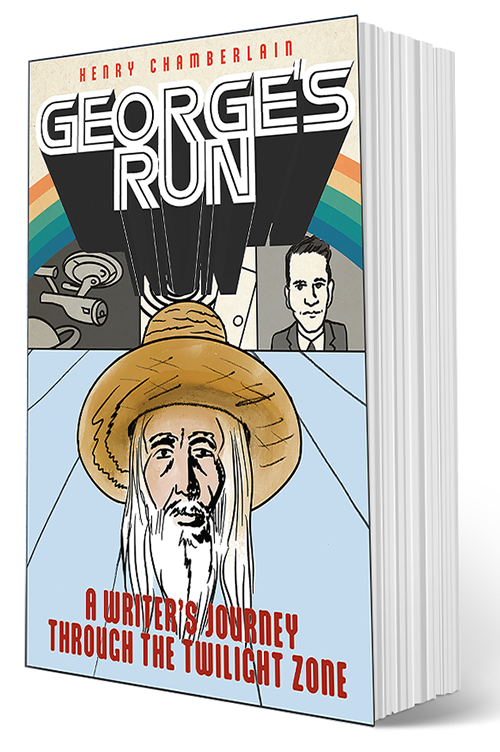
As someone who is putting together a graphic novel that is directly related to The Twilight Zone, I am particularly intrigued by this reboot. I see the minor blemishes too. But, overall, this is a series that has its ducks in a row and I feel confident that Rod Serling, given a chance to process where we are today, would grin and give the show his blessing.
Share this:
Like this:
9 Comments
Filed under CBS All Acess, Comics, Rod Serling, Television, The Twilight Zone
Tagged as CBS All Access, comics, Entertainment, Fantasy, Fiction, graphic novels, Horror, Media, Movies, Pop Culture, Publishing, Rod Serling, Science Fiction, Social Commentary, Television, The Twilight Zone