
GEORGE’S RUN
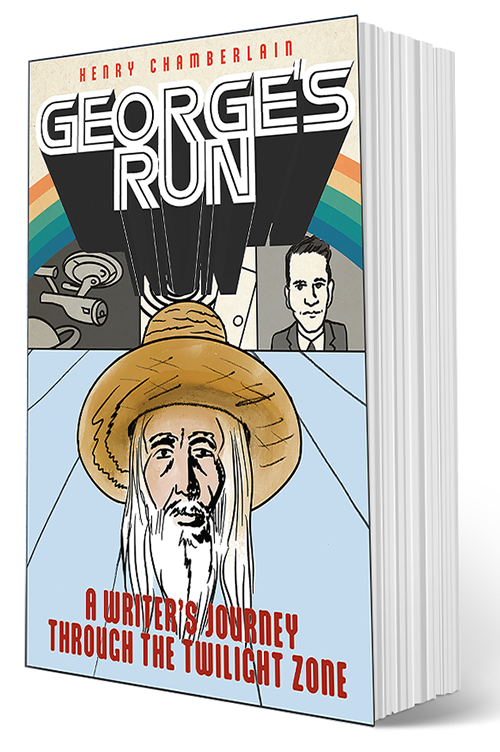
The graphic novel, GEORGE’S RUN, is scheduled for a special indie release during Small Press Expo, September 12-13, 2020. This is a 200-page graphic novel that features the life and times of science fiction writer George Clayton Johnson. In his day, George earned his way into the inner circles of such legends as Rod Serling, Ray Bradbury, and cult literary favorites, Charles Beaumont, and Theodore Sturgeon.
GEORGE’S RUN is a story about storytelling. It’s not about just one thing and could easily be misunderstood but it’s worth giving it your attention.
Henry Chamberlain is your host. He is a cartoonist through and through. He wrote and drew this graphic novel that we’re talking about. Heck, our pal Hank has been behind the whole project from initial thumbnails to digital coloring. The guy could use a little help. For that, consider some of the awesome shout-outs he has earned from some VIPs who care about quality entertainment:
“It clearly is an act of passion!”
— Jeff Smith, creator of the comics series, Bone

“It’s really a one of a kind tale: a madcap ride back into our own pop culture told with a free-wheeling zest.
— Jerome Charyn, author of Cesare: A Novel of War-Torn Berlin

George Clayton Johnson’s Cafe Frankenstein
“GEORGE’S RUN tells the engaging story of George Clayton Johnson’s pivotal role in the core group of fantasy writers who wrote for The Twilight Zone and Star Trek, as well as his amazing novel Logan’s Run. Chamberlain’s graphic novel is a fascinating tribute to a writer who came out of nowhere to influence American fantasy writing forever.”
–Martin Olson, author of Encyclopaedia of Hell

George keeps on running!
GEORGE’S RUN
So, just to be clear, the book will make a number of introductions into the world with a special highlight being its SPX debut in September 2020. If SPX should be cancelled, it will still enjoy a special September online release. You can keep up with updates here and at the official website for the book. For all intents and purposes, you can consider the book published as of now since I’m providing you with an early bird view of it here.
As time progresses, you’ll be able to find GEORGE’S RUN in different formats and at other venues. A version in color will be out by September.





‘The Twilight Zone’ Hits the Ground Running
The Twilight Zone
The Twilight Zone reboot hits the ground running by finding a way back into what made the original series work and trying to avoid adding and tweaking more to it and messing up a good thing. Just one more thing tacked on can be like playing a game of Jenga where you tear down an otherwise neatly put together structure. Without spoiling anything, if there is one criticism to the show, it is that it needs to keep to this golden rule. For the most part, it does that and that bodes well for what it shaping up to being a lively and compelling return to a classic. This series comes to you from CBS All Access and is hosted by Jordan Peele.
What would Rod Serling think of viewing Twilight Zone on a phone?
I will fast forward to the second episode as it is an example of how this series is finding its feet. We immediately start with a fresh look at something not directly referencing an iconic episode as is done in the first episode. We’re at a comedy club, which is an ideal Twilight Zone setting if ever there was one: in the darkness, the audience as well as the performer are looking for some catharsis. Our main character, comedian Samir (Kumail Nanjiani), is stuck on speaking truth to power but he’s not connecting with his audience. Then he has a talk with a veteran comedian J.C. (Tracy Morgan). The main bit of advice: Don’t try to make points; Go for the laughs by keeping it personal–but beware that once you take from your life, it’s out there and you can’t get it back. Samir goes against his better judgement and makes a detour that gets him the laughs.
Jordan Peele channeling Rod Serling
“The Comedian” is not a direct reference to any particular TZ episode, not like Richard Matheson’s monumental airplane nightmare. But it is a sly tip of the hat to Rod Serling nonetheless, just a sweet little Easter Egg (there are others, as in names used for some characters) as it refers back to one of Serling’s landmark teleplays prior to TZ. It is that sort of deep dive that will send a nice chill of recognition for diehard fans. The scirpt’s writer, Alex Rubins, would certainly be aware of that. So, we’ve got a character in crisis: Samir has made some devil’s bargain. All is set up for the chilling fun and it is delivered. In this case, a little editing somewhere in the middle to tighten things up would have been ideal. As for the end, it is spot on.
Twilight Zone on CBS All Access
I think the challenge for this reboot is satisfying an audience that is happy to take things further, like a kid in a candy store who risks a stomach ache. The first episode, “Nightmare at 30,000 Feet,” makes that mistake by pushing a bit beyond what would have been a perfect ending. And the second episode makes that mistake by packing it bit more background that drags an otherwise excellent story. There’s a very good reason that Serling and the rest of his writers concluded that the sweet spot for the show was the original half hour format. With streaming, the restrictions are lifted and so the creative team (a producing team that includes Glen Morgan, Greg Yaitanes, Simon Kinberg, and Jordan Peele) needs to be mindful of being disciplined storytellers. That said, my guess is that you can expect this reboot to indulge in providing viewers with a deluxe director’s cut excess. That could be very good news for some fans. Then again, who knows, maybe adjustments will be made and we’ll get this reboot refined to perfection.
As someone who is putting together a graphic novel that is directly related to The Twilight Zone, I am particularly intrigued by this reboot. I see the minor blemishes too. But, overall, this is a series that has its ducks in a row and I feel confident that Rod Serling, given a chance to process where we are today, would grin and give the show his blessing.
Share this:
Like this:
9 Comments
Filed under CBS All Acess, Comics, Rod Serling, Television, The Twilight Zone
Tagged as CBS All Access, comics, Entertainment, Fantasy, Fiction, graphic novels, Horror, Media, Movies, Pop Culture, Publishing, Rod Serling, Science Fiction, Social Commentary, Television, The Twilight Zone