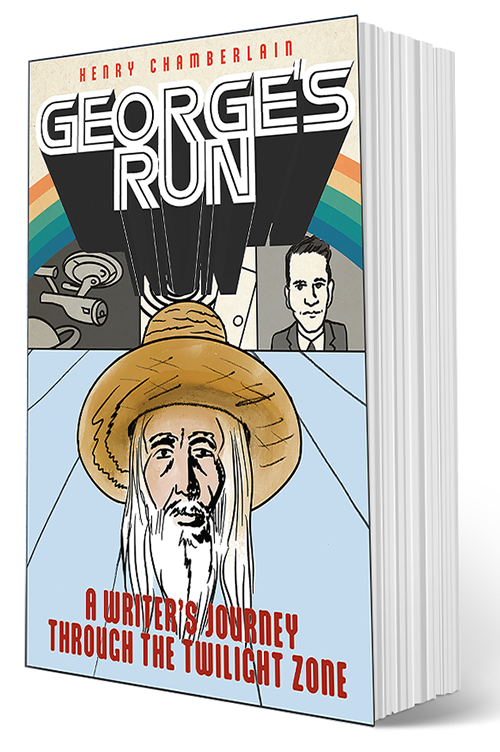
For all of us in the comics community, whether creators or fans, it is time once again for the Short Run Comix & Arts Festival. There’s a nice write-up about it in the local alt-weekly, The Stranger, that you can check out here. Among a splendid array of comics that you will have a chance to choose from, I humbly add something I am working on. This is the first installment to a full-length work. It’s called, “George’s Run,” and it’s about the life and times of science fiction writer George Clayton Johnson. I am still in the process of weaving the narrative but this is a perfect time to share some of what I’ve put together thus far. If you happen to go to Short Run, you’ll have a chance to buy a copy of this 24-page comic. You can find me at the Short Run tables under the name, Comics Grinder Press.
Short Run Comix & Arts Festival takes place this Halloween: Saturday, October 31, in Fisher Pavilion at Seattle Center from 11 am to 6 pm.
For more details, be sure to visit our friends at Short Run right here.
Jason V Brock is an author, artist, and filmmaker who finds himself in a very interesting place in pop culture. For starters, he has created two well-regarded documentaries that focus on two very different men, both great contributors to science fiction, horror, movies, television, and the arts in general. One is Charles Beaumont. The other is Forrest J Ackerman. We chat about them and the creative process. How do you create art? One rule of thumb: Do it yourself! We begin with a look back at Brock’s childhood and how he, a child of the ’80s, grew up with the DIY ethos. In Charlotte, North Carolina. That’s where Brock cut his teeth on comics, retro cinema, vintage LPs, pulp fiction, and Playboy. Brock began working at his local comic book shop at the age of 13. His dad was a writer and graphic designer. It sounds like an idyllic way to grow up, right out of a Ray Bradbury story.
Charles Beaumont and Robin Hughes on the set of “The Howling Man”
Speaking of stories,there are so many stories to cover just in Brock’s documentary on Beaumont. Take the case of the short story, “The Crooked Man,” by Charles Beaumont. It is a classic today that was highly controversial for the time, circa 1955. It imagined a society where homosexuality was predominant while hetrosexuality was outlawed. The story was bought by Esquire but subsequently was not published. It turned out to also be too hot for the pages of The Magazine of Fantasy & Science Fiction. But when Playboy published it in 1955, then that same story became okay, more than okay. Charles Beaumont sold his first science fiction story, “The Devil You Say,” to Amazing Stories in 1950. By 1954, he had written the first work of fiction, the landmark work, “Dark Country,” to appear in Playboy in 1954. This kicked off over a decade of Beaumont stories in Playboy. Writing for movies and televison soon followed including some of the best episodes of “The Twilight Zone.” All this, and so much more, before his life was cut short at 38 by a mysterious illness.
And, that gives you some sense of what to expect in Brock’s “Charles Beaumont: Short Life of Twilight Zone’s Magic Man.” You can find that documentary as well as Brock’s documentary on Famous Monsters of Filmland’s former editor, Forrest J Ackerman (Uncle Forry), “The AckerMonster Chronicles!” right here.
We also chat about Brock’s work in editing and writing his own stories. This led us to discussing a unique pairing of talents. In the course of working on the Beaumont documentary, Brock got to know one of the members of the Southern California Writer’s Group, William F. Nolan. They struck up a solid friendship. When Nolan was at a turning point on where he wanted to live next, it was a reasonable choice for him to move a bit further north from Bend, Oregon to Brock’s neighborhood in Vancouver, Washington. It turned out to be a natural fit and Brock and his wife, Sunni, could not be happier to share meals but not only that. Bill Nolan became family and you look out for family.
Among Brock’s impressive editorial work, there’s the recent anthology, from 2014, “A Darke Phantastique.” This is a 730-page lushly illustrated collection of some of the best dark horror fiction around with more than fifty stories, poems, and one teleplay. This includes Joe R. Lansdale’s “The Case of the Four-Acre Haunt”; Paul Kane’s “Michael the Monster”; William F. Nolan’s “The Last Witch”; Nathaniel Lee’s “The Wisest Stone and the Zoo”; Derek Künsken’s “The Buddha Circus”; E.E. King’s “Three Fables”; Jason Maurer’s “In Your Dark: Differing Strategies in Subhuman Integration Through Monster Academies” and S.T. Joshi’s “You’ll Reach There in Time.” “A Darke Phantastique” is published by Cicatrix Press and you can find it here.
And another recent anthology, out this year, is “Disorders of Magnitude.” This is a 336-page overview of the genres of horror, science fiction, and the supernatural. It will prove useful to anyone who wants a better understanding of the roots of one of today’s dominant forms of entertainment and art. Included in this collection are essays, reviews, and interviews. Brock studies such dynamic figures as H. P. Lovecraft, Forrest J Ackerman, Harlan Ellison, Ray Bradbury, Charles Beaumont, Richard Matheson, Rod Serling, and William F. Nolan. This collection also includes filmmakers Roger Corman, George Romero, and Dan O’Bannon, and such fantasy artists as H. R. Giger. “Disorders of Magnitude” is published by Rowman & Littlefield Publishers. You can find it as Amazon right here.
You can listen to our conversation by clicking the link below. For anyone interested in writing, filmmaking, and creativity in general, there’s something here for you. Enjoy.
And be sure to visit Jason and Sunni Brock at JaSunni Productions to find out more about their products and services right here.
William F. Nolan and George Clayton Johnson. Art: Henry Chamberlain
William F. Nolan is a writer with a brilliant career. Stephen King has acknowledged Mr. Nolan as “an expert in the art and science of scaring the hell out of people,” and Ray Bradbury has spoken of Mr. Nolan’s ability “to create an atmosphere of ultimate terror.” Crafting an interview with him can take a variety of directions. You could focus on race car driving, movies, television, horror, or science fiction. I chose to talk about genre fiction, specifically the pulp era, as Mr. Nolan is an authority on that subject. And, of course, we made our way to the biggest title that Mr. Nolan is attached to, Logan’s Run. He co-wrote, with George Clayton Johnson, the original novel and has gone on to write further Logan’s Run novels as well as the pilot episode to the television series.
Imagine yourself a young person with big plans to embark on a career in writing. It’s the 1950s. You’ve made it out to Los Angeles. You grew up reading pulp fiction. You adore it. Max Brand Westerns are the best! But you also love hard-boiled detective stories. Who better than Dashiell Hammett to deliver on that score, right? And then there’s science fiction. If only you might meet up with your hero, Ray Bradbury. Wouldn’t that be the tops? Sure enough, you meet Ray Bradbury. Not only that, Mr. Bradbury takes you under his wing and helps set your writing career on a high-flying course. That would be your first published story, “The Joy of Living”, in If magazine in 1954. Welcome to the life of William F. Nolan.
We focus on three major writers and, in turn, see how Nolan learned from them, adopted their techniques and tenacity, to become a professional writer in his own right. We talk about Ray Bradbury and his penchant to pay it forward with other writers. “We all support each other,” Nolan says. We talk about Frederick Faust, known as “Max Brand,” among other pseudonyms, and his uneasy relationship with fame. As for Faust’s all-time famous title, “Destry Rides Again,” it paled in comparison to his devotion to writing poetry, which never sold. It’s a similar case with Dashiell Hammett. Despite his wildly popular “Thin Man” stories, he wasn’t satisfied and had hoped to develop writing beyond his genre, but never did. Oddly enough, despite any reservations from Faust or Hammett, all three of these writers are held in high regard. But only Bradbury was to live to see and appreciate his place in fiction as well as his notoriety.
It’s a perplexing predicament to be, or aspire to be, a writer. “The problem is that most students of writing are lazy,” Nolan points out. “They want to become Stephen King over the weekend. Well, you can’t become Stephen King over the weekend. Stephen King couldn’t do that. People have some idea that he’s always had it easy and been rich. But, no, he spent ten years writing and struggling before ‘Carrie’ came along and made him a tidy sum of money.” And far be it for a writer to always be the best judge of his own work. As the story goes, King threw away the manuscript to “Carrie” in a fit of frustration. He tossed it into a waste basket only to have his wife fish it out and persuade him to send it to his agent. Good thing he did just that.
“Writing is like a roller coaster,” Nolan says. But he is also inspired to share the fact that hard work will pay off. What best illustrates this is just talking shop with him. For example, you get great insight exploring the work that Nolan has done with George Clayton Johnson. Among the dozen or so writers that Nolan has worked with, it is with Johnson that he wrote his first teleplay and, years later, his first novel. It was to be firsts for both of them. In 1959, Nolan and Johnson wrote their first teleplay, “Dreamflight,” for “The Twilight Zone.” It was never produced. Thanks to the jet age, the show found itself with one too many airplane-related stories. It’s since been printed in the anthology, “Forgotten Gems.” And it is a gem, a modern day take on Sleeping Beauty.
In the intervening years, Nolan and Johnson would continue to grow as writers, in no small measure due to the collaborative process they developed as part of what became known as The Southern California Writers Group. And so they did work together again, including two unproduced “Star Trek” teleplays, finally leading up to one of the best collaborations ever, the original “Logan’s Run” novel.
As we closed out our interview, I asked about upcoming projects and William F. Nolan is, at 87 this March, as busy as ever. On his list of top priority items, he included his longtime friend and collaborator, writer/artist/filmmaker Jason V. Brock, who is set to work with Nolan on a new Logan’s Run novel that will deconstruct what has come before and is entitled, “Logan’s Fall.” Also on the list: “Images in Black,” an edited collection of Ray Bradbury stories with an African-American theme; “A Man Called Dash,” a definitive biography of Dashiell Hammett; “Soul Trips,” a collection of Nolan poetry; and a Nolan horror collection for the series, “Masters of the Weird Tale,” to be published by Centipede Press.
Just click below to listen to the podcast interview. Enjoy:
FAMOUS MONSTERS #272 HISTORY OF SCI-FI (NEWSSTAND)
Consider this scenario: A man finds himself apparently the sole survivor of a world-wide pandemic. He searches for more survivors and a cure. Sound familiar? Well, welcome to the source: Richard Matheson’s groundbreaking 1954 Sci-Fi classic, I AM LEGEND. Or about this scenario: A world-wide plague has wiped out most of the population. Survivors fight for what little resources remain. Again, sound familiar? Well, go back even further to another source: Mary Shelley’s groundbreaking 1826 Sci-Fi classic, THE LAST MAN. Starting to see a pattern? You get a look at a wide variety of Sci-Fi interconnections in the latest issue of FAMOUS MONSTERS, #272. Half the issue is a tribute to writer Richard Matheson, who passed away in 2013, and the other half is a brief history of Sci-Fi literature.
FAMOUS MONSTERS #272 RICHARD MATHESON (DIAMOND/SUBSCRIBER)
The upcoming issue of Famous Monsters will be a tribute to a giant in science
fiction, Richard Matheson. Yes, he’s the guy who wrote that famous episode of The Twilight Zone with William Shatner freaking out at seeing a gremlin on the wing of the plane he’s on, “Nightmare at 20,000 Feet.” He was a prolific writer and wrote one of my favorites, BID TIME RETURN, which became the movie, SOMEWHERE IN TIME, starring Christopher Reeve.
Dennis Weaver in Steven Spielberg’s “Duel,” written by Richard Matheson
One of the great writers for “The Twilight Zone,” Richard Matheson, passed away this year. As we observe that fateful date in Dallas, November 22, 1963, I think of how one man created art out of the processing of his emotions from that event. You might find this to be a surprise but “Duel,” the short story about a man fighting for his life against a demonic semi-trailer truck, that went on to become Steven Spielberg’s first major movie, has its origins in the Kennedy assassination. It’s not a direct link. It’s more based on a significantly deep dark feeling of despair and dread.
George Clayton Johnson is a born storyteller. Listen to him and you’ll find a good yarn told by someone with a love for the spoken and written word. He is, after all, one of the big players of pop culture: Among his credits: writer of landmark episodes of THE TWILIGHT ZONE; writer of the first broadcasted episode of STAR TREK; co-writer of OCEAN’S ELEVEN; co-writer of LOGAN’S RUN. For this interview, George and I began to talk about William Shatner. I was thinking over how William Shatner can be misunderstood as only being brash when that’s definitely not the case. With “Star Trek Into Darkness” arriving in theaters on May 17, Mr. Shatner was an excellent point of departure.
William Shatner in “The Intruder”
We quickly moved forward with a look back to Roger Corman’s 1962 “The Intruder,” a significant drama about the high tensions in the American South during the Civil Rights Movement. Mr. Corman was having difficulty in finding actors and approached Mr. Johnson, as well as his writing partner, William F. Nolan, about playing roles in the film. They were more than happy to join in. The film is based on the novel by Charles Beaumont, a science fiction writer, and a fellow contributor with Mr. Johnson to “The Twilight Zone.”
George then related a wonderful story about the origins of “Star Trek” and we ended with news of an exciting possibility. There is a tantalizing possibility of “The Twilight Zone” making its way to the stage. As George envisions it, the story would take place in a rest home, just like the famous “Kick The Can” episode. It would be about a seasoned writer who has had a lifetime of success and wants to knock one more ball out of the park. He has an idea for another story. This one will be about an individual focusing on a special moment, either in the past or the future. The trick is to avoid the present. In that way, you can live forever. In the course of the production, there will, in fact, be a series of stories and each will play off landmark “Twilight Zone” episodes that George wrote. And, to top it off, there needs to be a narrator, of course. Who better than Rod Serling? If all goes according to plan, this will be a musical.
Who would play the role of Rod Serling? Well, that brings us back to the subject we began our interview with: William Shatner is on the short list of possibilities. That is certainly an exciting prospect. Mr. Shatner came of age in that era, he knows the talent behind the original series, and he starred in one of the most memorable episodes, “Nightmare at 20,000 Feet.” He would be an excellent choice.
There are a number of details to consider about taking such a project, conceivably, all the way to Broadway. Not least of concerns is getting just the right tone to what the Rod Serling narrator would say. He might be presented like a hologram. And he certainly will have a vital role to play, much like the narrator of “Our Town.” It was very gracious of George to share this project in the making with us. He has a number of projects in the works and this one is very dear to his heart. These are the early stages. We all hope it will come together.
Other subjects we cover in this interview are what led up to the original novel, “Logan’s Run,” and what may lie ahead, and a most intriguing thing that happened when George Clayton Johnson and J.J. Abrams discussed working together.
George Clayton Johnson makes his living by daydreaming, as he has put it. And those dreams have led him to some amazing places. You may know about him already or, perhaps, you’ve heard of his work. The story that he co-wrote with Jack Golden Russell was the basis for the 1960 and 2001 films, “Oceans Eleven.” He wrote the first aired episode of “Star Trek.” With William F. Nolan, he co-wrote the novel that was the basis for the cult classic film, “Logan’s Run.” Along with other remarkable television writing and countless science fiction stories, Mr. Johnson wrote some of the most poignant and beloved episodes of “The Twilight Zone,” including “Kick The Can,” which was remade in the movie version.
Mr. Johnson’s life is the stuff of legend. He was born in a barn, in 1929, Cheyenne, Wyoming, and not exactly set on a path for the success he has achieved. But with a strong force of will, George Clayton Johnson gave his life shape and purpose. Leaving behind a troubled upbringing, he set out at the age of fifteen to make his living as best he could. He started out as a shoeshine boy. Later, in the army, he mastered the job of draftsman and was involved with charting the intricate underground wiring systems related to the Panama Canal. By the late ’50s, he had set his mind on being a writer and this led to his story about an outrageous Las Vegas casino bank heist. This became his calling card and led to his joining a group of elite science fiction writers in Southern California. From there, he met Rod Serling who just happened to be preparing for a new show that would chart a new course for television, “The Twilight Zone.”
Where to begin with such a talent? One big point of interest: the remake of “Logan’s Run.”
Here is my tribute to one of the great episodes from the landmark television series, “The Twilight Zone,” (first episode, October 2, 1959; final episode June 19, 1964). There is so much that can be said about this show. It was definitely a part of the zeitgeist and helped to set the tone of the counterculture movement as it made its way into the mainstream. “A Penny For Your Thoughts” is a classic TZ test of character as the walls come down covering up everyday civility for one man. Suddenly, Hector Poole can hear everyone’s thoughts and they’re often hostile and conniving.
One moment, he’s just a man buying a newspaper. But the quarter that Hector drops in the vendor’s box lands on its edge and triggers something supernatural. Hector has telepathic powers. Is this a curse or a gift?
This was George Clayton Johnson‘s first teleplay for the show. Before that, he had contributed two stories to TZ. Mr. Johnson was already flying on a rising star since his work on the story that was the basis for the Rat Pack classic, “Ocean’s Eleven,” (1960).
“A Penny For Your Thoughts” is from Season 2, Episode 52, originally airing on February 3, 1961.