From the first page of Kara Queen’s new comic, “A Wind From Nowhere,” I felt as if I had been invited into a quiet space where secrets were revealed through whispers. There is 11-year-old Madelyn sitting on the rooftop of her apartment building talking to Ichabod, a one-legged crow. Then, one day at school, her world is rocked by a boy named, Harper.
Kara Queen has a solid way of evoking the vulnerability of youth. She takes her two main characters, inevitably lacking in self-awareness, and places them on a treacherous journey that both are unlikely to survive. This is a study of a crisis that just keeps getting further out of control. Perhaps Madelyn and Harper should never have met but, despite the cloud that hangs over them, they seem to be meant for each other.
A WIND FROM NOWHERE by Kara Queen
The ill-fated relationship has everything to do with their instability. Neither one has much of a foothold on reality. At least Madelyn’s offbeat perspective leans to the whimsical. Harper’s view of the world veers towards homicidal.
Madelyn, Harper, and the crows
There’s a lot of heart to this comic. You really believe in the characters and their struggles. Queen has an energetic and compassionate drawing style. As you might have suspected, there isn’t much in the way of healthy parental support for these kids. But Queen is careful not to paint them as monsters. Instead, she manages to evoke that murky world of dysfunction where things just aren’t working the way they should be.
“A Wind from Nowhere” is a 50-page full-color comic, priced at $12, and available right here. And be sure to visit Kara Queen right here.
Do you like to write lists of goals you’ve set for yourself or give yourself little private pep talks? Of course, you do! We have plenty of bad energy out there to navigate through. A lot of us out there have already picked up on the benefits of self-help, particularly meditation. Yumi Sakugawa has a new book, “There is No Right Way to Meditate and Other Lessons,” published by Adams Media. Here, she provides a highly accessible, and quite invigorating, look at a peaceful world full of peaceful people.
It all began with an epiphany that Yumi had when she was 23-years-old and feeling very blue. She came to the realization that she was NOT her thoughts. She certainly wasn’t her negative thoughts. It is a simple enough concept and yet it is also a very powerful concept. This is a book that gently, and soothingly, offers observations on how to avoid negativity and gain a better sense of balance.
Yumi maintains a lighthearted tone throughout with her prose and whimsical artwork. For instance, she suggests that you get lost in the woods so your bad mood doesn’t know where to find you. It’s not too lighthearted. It’s just right. These are mind over mind exercises. So, the humor needs to ring true. The inner world won’t respond to a mere joke.
There’s such a genuine expression of joy and reassurance here that you’ll find it irresistible. No right nor wrong. No irony. Just a goal of self-love. Perchance to dream. Ah, dreams are a serious business. The mind demands convincing. Yumi will do this by presenting the reader with a rock. The rock is heavy. Anxiety is heavy. However, once you start to feel the rock’s ridges, it begins to feel less heavy. Yumi invites you to desire a better life without thinking too hard about it. Enjoy the now. That is exactly where you need to be.
“There is No Right Way to Meditate and Other Lessons” is a 160-page hardcover and is published by Adams Media. You can also find it at Amazon right here.
We think a lot about garbage here in Seattle. We’ve been ahead of the curve for many years. We separate our garbage from common garbage (non-food), compost (food), and recycling (very specific categories). I know that some Seattleites find utter joy in thoroughly washing their recyclables. And, lately, the City of Seattle has demanded more by showing no mercy and fining homeowners who dare to mix food in with their common everyday garbage!
To read TRASHED, the new graphic novel by Derf Backderf, this whole business of garbage is not so complicated. The real solution would be to use less! But I get ahead of myself. In this book, you see the very human element to garbage from the viewpoint of a bunch of young guys just starting out in life…as garbage collectors.
Derf Backderf has a style and tone to his storytelling that brings you right in. You might not necessarily want to be brought in to some of the content he’s involved with but, all the same, there you are. From his comic strip that examined Cleveland urban life to his previous recollections of Jeffrey Dahmer, Backderf presents the grim, the gritty, and the unvarnished truth. For his new graphic novel, he does something that may inspire other cartoonists to follow suit in their own way.
He revisits some experiences from his youth and brings these old characters up to present day with contemporary commentary. Backderf created comics based upon his year (1979-80) as a sanitation worker. In 2010, he took those old characters and, like ageless Archie comics characters, placed them in a present day setting for a webcomic. That project evolved into this current graphic novel.
Backderf gently nudges along the idea that we’re all such disgusting slobs. Maybe not all of the time but no one gets completely away. And there are plenty of oddball characters that Backderf observes on his rounds who shouldn’t get away with anything like the unscrupulous dog catcher that terrorizes all the neighborhood pets. And then there’s all the people leaving out inappropriate items like a stove and a car engine block. Seriously? Yes, people have no shame.
Knee-deep, and sometimes up to his eyeballs, in garbage, our main character prevails. He survives his year as a garbage collector. And, now, all these years later, we get the complete story in this funny, insightful, and beautifully rendered book.
TRASHED is a 256-page hardcover, published by Abrams ComicArts, available as of November 3, 2015. You can find it at Amazon right here.
Tom Van Deusen is a cartoonist based in Seattle who, along with several other cartoonists, started up the quarterly comics newspaper, Intruder. His work includes the comics, “Eat Eat Eat,” and “A Matter of Life and Death.” He was instrumental in bringing back the comics anthology work associated with writer Dennis Eichhorn and “Real Stuff.” Tom’s Poochie Press brought out two issues of “Real Good Stuff.” Subsequently, Last Gasp published, “Extra Good Stuff.” This was an opportunity to revisit previous collaborations as well as new ones between Mr. Eichborn and cartoonists.
Real Good Stuff #2
Dennis P. Eichhorn died October 8, 2015. He was one of the autobio genre’s best-known luminaries. Once nominated for three Eisner Awards for his work in Real Stuff comix, Eichhorn also authored the Real Smut comix series, and self-published The Amazing Adventures of Ace International, Real Schmuck, and Northwest Cartoon Cookery in collaboration with Starhead Comix. A former senior editor of Seattle’s now-defunct Rocket Magazine, Eichhorn distingished himself as the creator of one of America’s most notable art tabloids, the Northwest EXTRA!, by editing and publishing 16 issues in the late 1980s.
Tom Van Deusen’s art on the cover of Seattle Weekly
Tom Van Deusen loves to create art: words, pictures, and words & pictures. He dose it quite well and seemingly effortlessly. That is part of the appeal, for me, as I see him as someone who simply loves what he does.
Tom Van Deusen’s “Space Duck”
The image above is a good example. I was looking through items he’s posted and thought I’d ask him about the duck on the moon. Tom laughed and, almost apologetically but not quite, said that it goes back to his just drawing for the sake of drawing.
Tom has taken the comics bull by the horns and accomplished a lot in these last four years that he’s focused on comics. Although, truth be told, he’s been creating art for longer than that. Most notable for him has been his work with writer Dennis Eichborn. We talk about Eichhorn, the world of comics, and the world of an indie cartoonist. Aspiring cartoonists will often ask cartoonist vets about how to break into comics, if there’s some secret handshake involved, and Tom is a shining example of what’s really involved: a simple love for the work.
Henry Chamberlain: Tell us about your connection with Dennis Eichborn.
Tom Van Deusen: I met Dennis Eichhorn through Pat Moriarity, who is a great cartoonist and worked with Eichhorn on the original run of Real Stuff. I’m a big fan of his work as is my friend and fellow cartoonist, Max Clotfelter, and a whole lot of other cartoonists. Max had been keeping up with a sort of football blog that Dennis was doing. Actually, it was more of a newsletter that he’d email to friends. It was mostly about college football but it also included a fair amount of autobio work. And Max contacted Denny about maybe working together on creating comics. At that point, Eichhorn hadn’t formally published anything in about twenty years.
He had these great new stories and, from that, we asked him he’d be interested in working with a new generation of cartoonists. And Kaz knew him and wanted to work with him again as well. And he agreed. I had these ideas at the time of doing some small scale publishing work. I had self-published for a few years my own comics. So, we decided to do a Kickstarter. We drove over to Bremerton and met with Dennis. I think I only met with him four or five times. We had a very successful Kickstarter, almost doubled our goal.
We got to put out a 64-page double issue and worked with a lot of great cartoonists. Noah Van Sciver wanted to do one. We got cartoonist from the original Real Stuff, like John Hurley and Mary Fleener.
And from there, Dennis had all these other stories he hadn’t published and that led to a second collection that was picked up by Last Gasp. Distribution is really tough. And, for me with a full-time job and trying to create my own comics, getting this book published has been the hardest thing I’ve done so far. It was really lucky to get Last Gasp on board to publish the second volume.
HC: I loved that I got to pick up my copy of that second book at the Seattle ferry terminal, of all places.
TVD: Ha, what was it doing there?
HC: There’s a great story behind that. Dennis Eichhorn’s wife, Jane, let me know that she arranged to have it available at the newsstand there since that was her regular spot to pick up the Sunday New York Times for Dennis on her way back to Bremerton.
TVD: Oh, that’s great!
HC: I wanted to ask your take on underground comix.
TVD: Well, from the ’60s or ’70s, or more recent?
HC: Yes, it is era-based. Take your pick. How would you define it, overall, for people totally unfamiliar with this?
TVD: Anything that’s not mainstream. And mainstream usually means genre work. That’s work that’s never really interested me. Even growing up, I never read superhero comics. I was more into “Ren & Stimpy” and a bunch of other crazy cartoons coming out when I was a kid. When I finally started getting into alternative comics in college, I picked up Crumb and Chris Ware. I think that goes hand in hand. It’s work that isn’t genre…which is sort of a sad description since most things aren’t genre. Most things aren’t “superhero” and “action” outside of comics. But, for some reason, comics are so dominated by things that are more suitable for children. Underground comix are more suited for adults, although they don’t necessarily have to be.
Alternative comics can be anything. And, once I found that work, I was really excited that I’d found my calling. It took a long time. They’re kind of hard to find. Distribution is crumby. Unless you know about it, it’s kind of hard for people to stumble across. It deserves a wider audience. It shouldn’t have to be “underground.” In France, this is major media. It’s not something just for enthusiasts. In Japan, everyone reads comics.
HC: It’s good to hear you use the term “alternative comics,” which I find very useful. It’s “alternative” to market-driven mainstream comics.
TVD: Right.
HC: How would you describe the scene today? I mean, from your vantage point. You’ve got The Intruder.
TVD: Yeah, there’s a lot of stuff coming out. It’s amazing. It seems that I meet a new cartoonist every day. With the internet, cartoonists are coming out of the woodwork quicker than ever. And there’s all these festivals. That’s what brought about The Intruder. We’d been reading Smoke Signal, which came out of Brooklyn’s Desert Island Comics. We want to create something for Seattle. There’s a great comics community in Seattle and always has been. I met Max Clotfelter, Marc Palm, Ian Fitzgerald, and other cartoonists. We hung out a lot. We all drew comics. From there, we did a lot of jam comics. We did a lot of silly, usually scatalogical, comics. We started out with a free newspaper and people seemed to like it.
The only problem is that there’s no money in doing any of this. The problem is distribution. There’s only one distributor, Diamond. They are pretty much closed doors for the sort of comics I enjoy. It’s a bottleneck for small publishers. They exist because of Marvel and DC Comics.
HC: Well, we won’t put too fine point on it. They do have a small press section in their catalog.
TVD: They do have that.
HC: You had mentioned a graphic novel that you really enjoyed in another interview you gave. That was last year’s sleeper hit, “Arsene Schrauwen,” by Olivier Schrauwen, published by Fantagraphics Books. I can see you doing something like that down the road.
TVD: For now, I am focusing on short works. “EAT EAT EAT,” is my longest work at 25 pages and that took four years.
HC: And you enjoy doing comedy.
TVD: That’s how I got into comics, from doing these PowerPoint presentations.
HC: There was a group that did a lot of that some years back called, Slide Rule.
TVD: Oh, really, are they local?
HC: Yes, it was a group of cartoonists in Seattle. I was part of that scene. David Lasky was part of that scene. He could tell you about it.
TVD: I gravitate to that. I enjoy writing up skits. There’s a great comedy scene where I’m from, Buffalo, New York. Great friends of mine there: Matt Thompson, Pat Kewley, and Sarah Jane Barry.
HC: Well, I am impressed with all the things you’re doing. You may end up focusing on writing in the future. Who Knows. I wish you well. Thanks so much for your time.
TVD: Thank you, Henry
You can listen to the podcast below:
Be sure to visit Tom Van Deusen right here. And you can find Poochie Press Publications right here.
If you happen to be reading this on the same day it was posted, Halloween, and you’re in Seattle, go see Tom at Short Run.
Alright, talk about follow-through, I completed my 24-Hour Comics Day marathon at the start of the month and here I am presenting the printed result, HELLO HELLO HOTEL HOTEL, at none other than the Short Run Comix & Arts Festival at the end of the month, yeah, and it’s even Halloween!
The Fremont Troll is one of the most celebrated of stone people. If you listen closely, you can learn from stone people. In this comic, we explore what transpires when the Troll takes on human form.
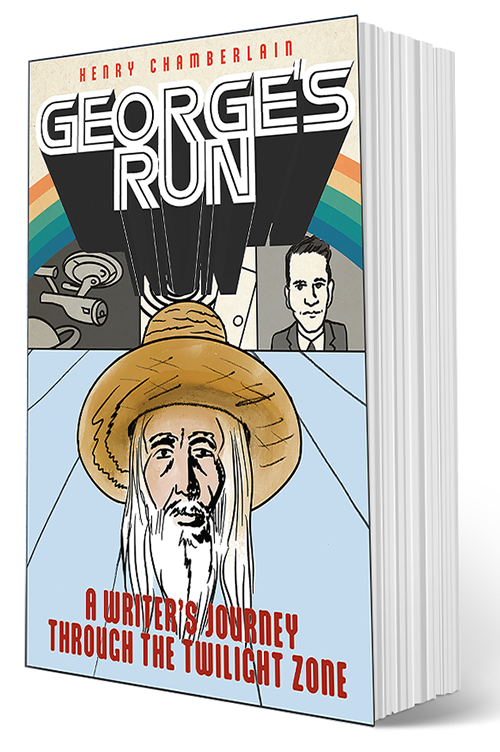
For all of us in the comics community, whether creators or fans, it is time once again for the Short Run Comix & Arts Festival. There’s a nice write-up about it in the local alt-weekly, The Stranger, that you can check out here. Among a splendid array of comics that you will have a chance to choose from, I humbly add something I am working on. This is the first installment to a full-length work. It’s called, “George’s Run,” and it’s about the life and times of science fiction writer George Clayton Johnson. I am still in the process of weaving the narrative but this is a perfect time to share some of what I’ve put together thus far. If you happen to go to Short Run, you’ll have a chance to buy a copy of this 24-page comic. You can find me at the Short Run tables under the name, Comics Grinder Press.
Short Run Comix & Arts Festival takes place this Halloween: Saturday, October 31, in Fisher Pavilion at Seattle Center from 11 am to 6 pm.
For more details, be sure to visit our friends at Short Run right here.
Searching through the past: the true story of Barbara Griffith emerges
As if drawn with invisible ink, there are mountains of comics from yesteryear that, even if popular in their day, will never be read again. But once upon a time, cartoonists were bona fide celebrities. Today, of course, everything has splintered off. But we still have some of the good stuff that harkens back to a golden age. We have Bill Griffith’s legendary comic strip, Zippy the Pinhead. Mr. Griffith is an expert on comics many times over and a masterful storyteller. He takes all that and gives us his first long-form graphic story, “Invisible Ink: My Mother’s Love Affair With A Famous Cartoonist.”
Cartoonist Bill Griffith channels Cartoonist Lawrence Lariar
Griffith navigates us through the often murky world of pop culture’s past and puts it into unique context. The past easily holds onto its secrets all too often because no one bothers to ever try to pry them open. This is a book about prying open the past and revealing the most intriguing secrets, family secrets. Much in the spirit of Griffith’s surreal Zippy the Pinhead, the mundane here collides with the supposedly more colorful world of mass media. Add to that, a decidedly offbeat look at the world. I swear, I found Zippy creeping up when you least expected it. For instance, there’s a scene in a diner between Bill and his uncle, Al, and Al says, “You know what’s coming back?” Bill asks, “Salisbury steak?” “No,” Al says, “morse code!”
The K & W Cafeteria in Winston-Salem, North Carolina
Check out the page above that I just made reference to with the morse code comment. Ah, such a thing of beauty! A perfect example of the Bill Griffith sensibility and I’m sort of just picking a page at random. It speaks to the very best spirit of underground comix which Bill Griffith came from. It articulates a worldview of someone finely tuned in to his feelings and observations. It is a very relatable view since we all feel we’re tuned in to the world around us. The idea is to create an expression of what one sees that touches on all the details of the moment and evokes a stream-of-consciousness. We see Griffith reacting to a quaint world of yesteryear still alive in the here and now. It’s a world where you can expect to order three different kinds of macaroni & cheese. Of course, the actual K&W Cafeteria doesn’t think of itself as out-of-date. It offers free Wi-Fi, after all. But, from Griffith’s perspective, it is a strange world to marvel over and that’s what we’re looking for!
You can imagine that Bill Griffith’s mother might have pretended she was writing with invisible ink in order to be as revealing as she was in her journals and related work. Whatever the case, we hear her loud in clear in this exploration of her inner life. Griffith synthesizes various artifacts to find a greater truth. When you go hunting for answers like this, you’re liable to get lost in your own issues with your parents. Griffith is no different in this regard. He is just like any of us trying to deal with the past and that is an excellent hook for readers. What makes this story extraordinary is that Bill Griffith has definitely met his match with his mother who gives his storytelling skills a run for their money. If truth is stranger than fiction, then this must be one hell of an example of that. It boggled the mind of Bill Griffith, one of the great mind-bogglers in comics.
“Invisible Ink: My Mother’s Love Affair With A Famous Cartoonist” is a 208-page black & white hardcover published by Fantagraphics Books. For more details, and to order, visit our friends at Fantagraphics Books right here.
PIZZA MAN: THE SUPREME COLLECTION by Damien Shanahan
Those of us who seriously follow the comics medium are always mindful of homegrown stuff. There’s a select group of us rooting for the indie cartoonist making it happen against all odds. As a cartoonist, I have a few more layers of empathy. I don’t need a work to fit any particular theme or agenda. I just need it to grab me. In the case of the book we have before us, I sense a kindred spirit right away. Damien Shanahan created a character in his youth and developed that character and his world. In the process, Damien Shanahan grew as a person, an artist, and so on. Sort of like Woody, from Toy Store, Pizza Man sat on a shelf for a while. But then Damien Shanahan got a craving for pizza again and the cheese was, once again, bubbling hot. The crust was crispy too. And it all led to “Pizza Man: The Supreme Collection.”
Opening story: “Comic Conned!”
Shanahan has done a lot of smart things with his Pizza Man over the years and that is reflected in the book. He knows how to keep it fresh. He begins the book with a new story that showcases his current art and writing skills. He knows how to bring the reader in. He kicks off with an informative introduction and also provides further explanation at the start of each section. He knows how to keep it moving. I think Shanahan does a great job of presenting his older work in the best light. And he knows when to share in the fun. There are some awesome pieces here with other artists drawing Pizza Man and the gang.
From “Viva Las Pizza,” art by Chris Wahl
Pizza Man brings to mind Flaming Carrot and other parodies of the superhero genre. There have been parodies for as long as there have been superheroes. Funny thing is that even your most unconventional superhero is liable to get complacent and start to act too much like a traditional superhero. In that regard, Shanahan demonstrates a keen sense of humor and dedication to remain as weird as possible. I really enjoyed the new work that begins this book. He has Pizza Man and his sidekick, Mozzarella, posted at a booth at a comic book convention. These guys aren’t creators. They’re fictional characters. They have no vested interest in being at a comic book convention. So, whatever onlookers have to say to them, it really doesn’t mean a thing to them. If only it could be that easy for cartoonists.
In the course of all his adventures, we don’t dwell too much on how Pizza Man became Pizza Man. It’s nothing as dramatic as surviving some freak accident at a pizza parlor or escaping from some pizza planet. He just is what he is. That’s what I like most about Pizza Man. Shanahan seems to be comfortable to keep things simple while also playing up the absurdity of being a superhero. This is just the sort of vibe that a lot of comic book publishers find very appealing. And that should bode well for the future of Pizza Man.
I’m sure this book will be fun for both fans of superheroes and fans of superhero parodies. It will be of keen interest too for anyone interested in the storytelling process as Shanahan does a great job of documenting his creative journey. This collection was the result of a successful Kickstarter campaign. You’ll want to seek it out as it becomes more available.
Keep up with Damien Shanahan and Pizza Man right here.
Transmedia, content that includes more than traditional text and illustrations, is still so new. Basically, it is storytelling on multiple platforms: there’s not only a book but there is video, music, games, social media, and so on. I feel it’s going to take a number of years before the novelty wears off and things integrate more naturally, if they ever do. Take this latest hybrid of book, music, and social media: “H8 Society – How An Atomic Fart Saved the World.” It does not take on the whole transmedia spectrum but it is in the same ballpark. The intent is to bring in young readers and it is designed to be ideally read on a smartphone.
This is a young adult book which has an overall upbeat and dynamic vibe to it so there’s some real potential there to attract new readers. This is a sci-fi adventure of sorts that is meant to appeal to teens. That is absolutely the demographic that is being targeted. It is clearly stated in the title, and not just the idea of farts. The idea of haters is pretty obvious. A lot of buttons are pushed, including all the usual suspects of sex, drugs, and race. The story begins with a satire on a jihadist which is odd at best. There are also scenes you can call sexist at best.
The press release describes this book as “a first-of-its-kind ‘extreme reading experience’ that marries music, graphics, and literature to tell an unforgettable story about an apocalyptic American dream.” Much more to the point, this is light entertainment or contemporary pulp fiction. It is not literature. It’s just light stuff featuring popular music. This book is sort of a contemporary version of Annette Funicello and Frankie Avalon singing in “Beach Blanket Bingo.”
An illustration by Bill Sienkiewicz in “H8 Society”
Something that is strongly in its favor is that the book is punctuated with vivid artwork by master illustrator Bill Sienkiewicz of DC and Marvel Comics fame. And the music peppered throughout this story is an impressive collection of twenty-six indie songs (curated from over 4,000 ReverbNation submissions). You’ll be reading along for a while and then have the option to play a song that sort of goes with the narrative. For instance, Boomer and the gang are right in the middle of an exciting scene. To add to that reading, you may want to listen to Valora’s “Extreme.”
While you read “H8 Society” on your smartphone, you can listen to songs like Valora’s “Extreme.”
The story is a caper involving two rival teen gangs who must confront a global network bent on taking over the world through mind control. It’s not the most cutting-edge scenario but it gets the job done and proves to be as entertaining as any light sitcom you might stumble upon. The choice of music is fun and that’s probably the most intriguing thing about this project. From time to time, a reader, immersed in his or her own reader’s world, is open to supplemental material. If you get that right choice of song, it can have a very moving and lasting effect upon a reader and actually enhance the reading experience.
First, you need a worthwhile reading experience before you can enhance it. In the case of this book, it is what it is: a simple caper story. And maybe that’s just what some readers will want during a commute. One caveat, the creators of this book go by the name of 2Dans. They are two former MTV executives which adds to the sense of this being more of a packaged deal and less of something to take too seriously. But then, atomic farts were never meant to be taken seriously, right? Find out how you can access this book for free by visiting the official book site here.
The two cello players had been rapidly playing to the direction of Brian Wilson (played by Paul Dano). He had wanted them to evoke the sound of propellers. Each time, they got closer. But, after three hours, Brian’s brother Dennis (played by Kenny Wormald) had had enough. What was Brian trying to prove anyway? Moments later, we hear that iconic perfectly rendered propeller sound. There it is, for all eternity, an essential part of one of the greatest songs of the ’60s and of all time, “Good Vibrations,” and it was worth it! Not to confuse you, this is not a documentary, but, just for fun, here’s a studio session that is beautifully evoked in this film:
How could Brian Wilson have known it was going to be worth it? He had been getting resistance from all sides by his own family. It wasn’t just his backward-thinking brother, Dennis. It was also coming from his own father. The chasm between father and son had grown so large that Brian was forced to fire his dad (played by Bill Camp) from his role as manager. Murry Wilson wasn’t fazed by it and simply managed another band. It was all just business to him. But rigid adherence to the bottom line is anathema to creativity. What it requires is continuous leaps of faith. This is what Brian Wilson is all about and what this film is all about. Ah, here’s our trailer right below:
Paul Dano, as Brian Wilson, is profoundly good. I can only imagine how inspiring it was for him to be, in a sense, taking direction from Brian Wilson. The script is based on Wilson’s 1996 autobiography, “Wouldn’t it be Nice: My Own Story.” Well, Dano was certainly in good hands with the film’s director, Bill Pohlad (12 Years a Slave and The Tree of Life). As we come to find, Wilson was truly up against it and yet remained open to experimentation. Imagine those two cello players, pretty much out of their element and yet they were open to experimentation. And it would lead them to greatness: zuba-da-da-buda, zuba-da-da-buda, zuba-da-da-buda, zuba-da-da-buda, zuba-da-da-buda…faster and faster…until they got it just right.
But there’s so much more. John Cusack is equally miraculous as Brian Wilson in later years. We see hints of a downward spiral as the young Wilson courts disaster but we can’t help but think the eccentricity is too important. By the time we fast forward to the ’80s, we see Cusack portray only a shell of a man. On one particularly good day, he manages to muster up enough strength to flirt with a Cadillac salesperson, Melinda Ledbetter (played by Elizabeth Banks). It is in her eyes, that Brian Wilson sees a possible way back to a meaningful life.
And so begins a romance, a way back, and a way out. No sooner has Brian made contact with the outside world, than Dr. Eugene Landy (played by Paul Giamatti) has swooped down to control the situation. Giamatti does have a tendency to chew up the scenery but, in this case, his overacting seems to be spot on. It would take a larger-than-life character like Landy to try to hold back the likes of Brian Wilson. Cusack, who is usually quite good at striking a balance, gives us a portrayal of a man who genuinely, and quite humbly, feels in touch with great artistic ability.
There’s a wonderful scene during his courtship of Melinda where he plays a little tune for her. She says it’s beautiful. He responds that he wrote it for her. “And what happens to it now?” Melinda asks. Brian responds without even a hint of irony, “Nothing. It was just meant to be for that moment.” It is a scene like that one that just adds to the belief in a man who would have cello players repeat the same passage of music for over three hours.
Visit the official “Love & Mercy” website right here.





Review: ‘Invisible Ink: My Mother’s Love Affair With A Famous Cartoonist’ by Bill Griffith
Searching through the past: the true story of Barbara Griffith emerges
As if drawn with invisible ink, there are mountains of comics from yesteryear that, even if popular in their day, will never be read again. But once upon a time, cartoonists were bona fide celebrities. Today, of course, everything has splintered off. But we still have some of the good stuff that harkens back to a golden age. We have Bill Griffith’s legendary comic strip, Zippy the Pinhead. Mr. Griffith is an expert on comics many times over and a masterful storyteller. He takes all that and gives us his first long-form graphic story, “Invisible Ink: My Mother’s Love Affair With A Famous Cartoonist.”
Cartoonist Bill Griffith channels Cartoonist Lawrence Lariar
Griffith navigates us through the often murky world of pop culture’s past and puts it into unique context. The past easily holds onto its secrets all too often because no one bothers to ever try to pry them open. This is a book about prying open the past and revealing the most intriguing secrets, family secrets. Much in the spirit of Griffith’s surreal Zippy the Pinhead, the mundane here collides with the supposedly more colorful world of mass media. Add to that, a decidedly offbeat look at the world. I swear, I found Zippy creeping up when you least expected it. For instance, there’s a scene in a diner between Bill and his uncle, Al, and Al says, “You know what’s coming back?” Bill asks, “Salisbury steak?” “No,” Al says, “morse code!”
The K & W Cafeteria in Winston-Salem, North Carolina
Check out the page above that I just made reference to with the morse code comment. Ah, such a thing of beauty! A perfect example of the Bill Griffith sensibility and I’m sort of just picking a page at random. It speaks to the very best spirit of underground comix which Bill Griffith came from. It articulates a worldview of someone finely tuned in to his feelings and observations. It is a very relatable view since we all feel we’re tuned in to the world around us. The idea is to create an expression of what one sees that touches on all the details of the moment and evokes a stream-of-consciousness. We see Griffith reacting to a quaint world of yesteryear still alive in the here and now. It’s a world where you can expect to order three different kinds of macaroni & cheese. Of course, the actual K&W Cafeteria doesn’t think of itself as out-of-date. It offers free Wi-Fi, after all. But, from Griffith’s perspective, it is a strange world to marvel over and that’s what we’re looking for!
You can imagine that Bill Griffith’s mother might have pretended she was writing with invisible ink in order to be as revealing as she was in her journals and related work. Whatever the case, we hear her loud in clear in this exploration of her inner life. Griffith synthesizes various artifacts to find a greater truth. When you go hunting for answers like this, you’re liable to get lost in your own issues with your parents. Griffith is no different in this regard. He is just like any of us trying to deal with the past and that is an excellent hook for readers. What makes this story extraordinary is that Bill Griffith has definitely met his match with his mother who gives his storytelling skills a run for their money. If truth is stranger than fiction, then this must be one hell of an example of that. It boggled the mind of Bill Griffith, one of the great mind-bogglers in comics.
“Invisible Ink: My Mother’s Love Affair With A Famous Cartoonist” is a 208-page black & white hardcover published by Fantagraphics Books. For more details, and to order, visit our friends at Fantagraphics Books right here.
Share this:
Like this:
2 Comments
Filed under Bill Griffith, Comics, Comix, Fantagraphics Books, Graphic Novel Reviews, graphic novels, Underground Comics, Zippy the Pinhead
Tagged as Bill Griffith, Books, comic books, Comic Strips, comics, Comix, Entertainment, Fantagraphics, graphic novels, Media, Newspapers, Pop Culture, Publishing, Social Commentary, Underground Comics, Zippy the Pinhead