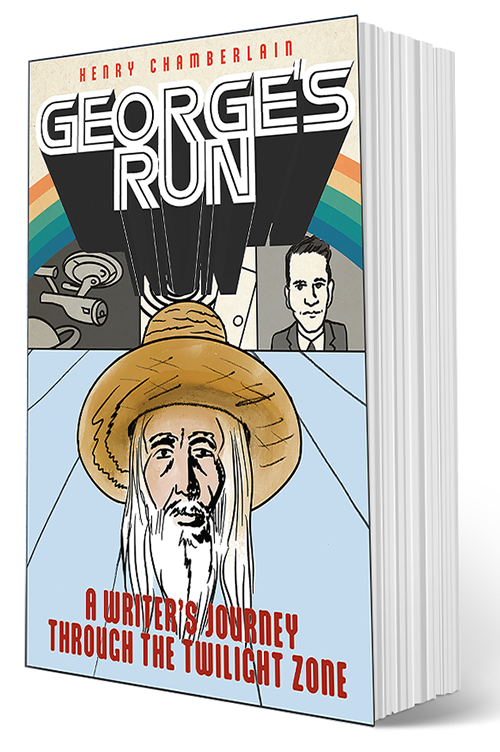
For all of us in the comics community, whether creators or fans, it is time once again for the Short Run Comix & Arts Festival. There’s a nice write-up about it in the local alt-weekly, The Stranger, that you can check out here. Among a splendid array of comics that you will have a chance to choose from, I humbly add something I am working on. This is the first installment to a full-length work. It’s called, “George’s Run,” and it’s about the life and times of science fiction writer George Clayton Johnson. I am still in the process of weaving the narrative but this is a perfect time to share some of what I’ve put together thus far. If you happen to go to Short Run, you’ll have a chance to buy a copy of this 24-page comic. You can find me at the Short Run tables under the name, Comics Grinder Press.
Short Run Comix & Arts Festival takes place this Halloween: Saturday, October 31, in Fisher Pavilion at Seattle Center from 11 am to 6 pm.
For more details, be sure to visit our friends at Short Run right here.
William Shatner and Wil Wheaton on “Brown Bag Wine Tasting.”
I really like William Shatner and I know I’m not alone. He’s a great talent and quite energetic. It would be a challenge for many of us to keep up with him. One project that he’s doing is entitled, “Brown Bag Wine Tasting,” a new web series from Ora TV where Mr. Shatner asks willing participants to blindly taste wine and describe it in terms of what they do. It’s a clever premise. I got a chance to check out the show and it lives up to what it promises to be.
It’s a breezy and light-hearted conversation that actually takes its subject of wine seriously. In a recent episode, it’s William Shatner in conversation with Wil Wheaton, actor and host of “Tabeltop.” Wheaton starred as Welsey Crusher on “Star Trek: The Next Generation.” As in every episode, it begins with some chatting. Shatner proves to be a genuinely interested and playful interviewer. We learn a little bit about the immersive quality of video games and the two speculate on life in other dimensions. Perfect themes to go with wine. And then Wil is challenged with describing his unidentified wine in terms of what he loves to do, brewing beer. It all runs for only a few minutes and I can honestly say that it holds its own among similar mini-webisode shows.
The latest interview on “Brown Bag Wine Tasting” with Wil Wheaton is live now. Go to Ora TV and you’ll see other episodes too ready for viewing. I checked out one with William Shatner interviewing Ray Isle, Executive Editor at Food & Wine magazine. And it also proved to be very informative and entertaining. New episodes premiere Wednesdays, 11am PST/2pm EST. Check it all out right here.
We live our lives and we’re not always aware of our achievements, our moments in the sun, that define us. For Leonard Nimoy, he was all too well aware of his legacy. His autobiography famously declared, “I Am Not Spock,” only to be followed years later with, “I Am Spock.” We all knew, all along, that he was Spock. This was not some burden. It simply was what it was. Pretty logical, and befitting a great actor and decent human being.
We will all miss Leonard Nimoy no longer among us. But we have his work to still enjoy. There’s that magical episode of Star Trek, “Amok Time,” written by Theodore Sturgeon, where Spock first says that famous line, along with the first time we see the Vulcan salute, “Live Long and Prosper.” He would wish that for you.
William F. Nolan and George Clayton Johnson. Art: Henry Chamberlain
William F. Nolan is a writer with a brilliant career. Stephen King has acknowledged Mr. Nolan as “an expert in the art and science of scaring the hell out of people,” and Ray Bradbury has spoken of Mr. Nolan’s ability “to create an atmosphere of ultimate terror.” Crafting an interview with him can take a variety of directions. You could focus on race car driving, movies, television, horror, or science fiction. I chose to talk about genre fiction, specifically the pulp era, as Mr. Nolan is an authority on that subject. And, of course, we made our way to the biggest title that Mr. Nolan is attached to, Logan’s Run. He co-wrote, with George Clayton Johnson, the original novel and has gone on to write further Logan’s Run novels as well as the pilot episode to the television series.
Imagine yourself a young person with big plans to embark on a career in writing. It’s the 1950s. You’ve made it out to Los Angeles. You grew up reading pulp fiction. You adore it. Max Brand Westerns are the best! But you also love hard-boiled detective stories. Who better than Dashiell Hammett to deliver on that score, right? And then there’s science fiction. If only you might meet up with your hero, Ray Bradbury. Wouldn’t that be the tops? Sure enough, you meet Ray Bradbury. Not only that, Mr. Bradbury takes you under his wing and helps set your writing career on a high-flying course. That would be your first published story, “The Joy of Living”, in If magazine in 1954. Welcome to the life of William F. Nolan.
We focus on three major writers and, in turn, see how Nolan learned from them, adopted their techniques and tenacity, to become a professional writer in his own right. We talk about Ray Bradbury and his penchant to pay it forward with other writers. “We all support each other,” Nolan says. We talk about Frederick Faust, known as “Max Brand,” among other pseudonyms, and his uneasy relationship with fame. As for Faust’s all-time famous title, “Destry Rides Again,” it paled in comparison to his devotion to writing poetry, which never sold. It’s a similar case with Dashiell Hammett. Despite his wildly popular “Thin Man” stories, he wasn’t satisfied and had hoped to develop writing beyond his genre, but never did. Oddly enough, despite any reservations from Faust or Hammett, all three of these writers are held in high regard. But only Bradbury was to live to see and appreciate his place in fiction as well as his notoriety.
It’s a perplexing predicament to be, or aspire to be, a writer. “The problem is that most students of writing are lazy,” Nolan points out. “They want to become Stephen King over the weekend. Well, you can’t become Stephen King over the weekend. Stephen King couldn’t do that. People have some idea that he’s always had it easy and been rich. But, no, he spent ten years writing and struggling before ‘Carrie’ came along and made him a tidy sum of money.” And far be it for a writer to always be the best judge of his own work. As the story goes, King threw away the manuscript to “Carrie” in a fit of frustration. He tossed it into a waste basket only to have his wife fish it out and persuade him to send it to his agent. Good thing he did just that.
“Writing is like a roller coaster,” Nolan says. But he is also inspired to share the fact that hard work will pay off. What best illustrates this is just talking shop with him. For example, you get great insight exploring the work that Nolan has done with George Clayton Johnson. Among the dozen or so writers that Nolan has worked with, it is with Johnson that he wrote his first teleplay and, years later, his first novel. It was to be firsts for both of them. In 1959, Nolan and Johnson wrote their first teleplay, “Dreamflight,” for “The Twilight Zone.” It was never produced. Thanks to the jet age, the show found itself with one too many airplane-related stories. It’s since been printed in the anthology, “Forgotten Gems.” And it is a gem, a modern day take on Sleeping Beauty.
In the intervening years, Nolan and Johnson would continue to grow as writers, in no small measure due to the collaborative process they developed as part of what became known as The Southern California Writers Group. And so they did work together again, including two unproduced “Star Trek” teleplays, finally leading up to one of the best collaborations ever, the original “Logan’s Run” novel.
As we closed out our interview, I asked about upcoming projects and William F. Nolan is, at 87 this March, as busy as ever. On his list of top priority items, he included his longtime friend and collaborator, writer/artist/filmmaker Jason V. Brock, who is set to work with Nolan on a new Logan’s Run novel that will deconstruct what has come before and is entitled, “Logan’s Fall.” Also on the list: “Images in Black,” an edited collection of Ray Bradbury stories with an African-American theme; “A Man Called Dash,” a definitive biography of Dashiell Hammett; “Soul Trips,” a collection of Nolan poetry; and a Nolan horror collection for the series, “Masters of the Weird Tale,” to be published by Centipede Press.
Just click below to listen to the podcast interview. Enjoy:
IDW Publishing has got the comics industry in quite a buzz regarding its acquisition of Top Shelf Productions, a relatively smaller comics publisher. So, what makes IDW special? Well, they do seem to have a geeky love for comics. And that leads to stuff like this collection of Star Trek stories. This is an IDW speciality so let that tell you something about IDW.
Perhaps when we think about science fiction, in general, we may still get lost. Even today, there are well-regarded writers in that genre, of great literary stature, who are due for a wider audience. In the case of Theodore Sturgeon, I am certain that, once a follower of his work, there is no turning back. What “More Than Human” achieves is nothing less than to inspire the reader. Its very purpose is to do just that.
If you’re in Seattle, and you love Star Trek, then there’s only one place to be this weekend. The Official Star Trek Convention returns to Seattle on December 12-14 with Jeri Ryan and Walter Koenig headlining the event!
My favorite episode of the original Star Trek series is “Man Trap,” by George Clayton Johnson. But there are certainly plenty to choose from. One of the crown jewels is by the great scribe, Harlan Ellison, “The City on the Edge of Forever.” Ellison’s teleplay, much like Johnson’s, went through revisions to make it a better fit for network television at the time. Now, thanks to IDW Plubishing, this classic story will be faithfully adapted as a five-issue comics series, just as Ellison had originally envisioned it.
That amusing Spock vs. Spock ad for Audi, with Leonard Nimoy and Zachary Quinto competing with each other, led me to the Audi Connect ads.
I think the spokesperson for these Audi Connect ads is a very charming young woman. She can appeal to a wide audience. And the car, from what we see of it, looks pretty cool. But what exactly is the focus here? So, Audi Connect is supposed to be a jaw-dropping leap into the future? Well, far be it from me to completely dismiss something that sort of makes driving safer. Sort of. It is less of an investment of your attention to talk to your car than to navigate your phone.
But, for all the bells and whistles, the scenario in this ad finds the young woman looking for a gas station after her mom has prompted her. Gasoline? In this day and age? Why not have this forward thinking consumer in an electric car already? Well, let’s give Audi a lot of credit for working towards that. They’ll get there. But first, they just wanted to focus on the most luxurious method to find your way to a gas station on your way to Los Encinos Park.
Audi used the A3 wagon to test its electric power train, in what could be its first production e-car (Credit: Wayne Cunningham/CNET)
Check out details on Audi’s development of its own e-cars, HERE.
George Clayton Johnson is a born storyteller. Listen to him and you’ll find a good yarn told by someone with a love for the spoken and written word. He is, after all, one of the big players of pop culture: Among his credits: writer of landmark episodes of THE TWILIGHT ZONE; writer of the first broadcasted episode of STAR TREK; co-writer of OCEAN’S ELEVEN; co-writer of LOGAN’S RUN. For this interview, George and I began to talk about William Shatner. I was thinking over how William Shatner can be misunderstood as only being brash when that’s definitely not the case. With “Star Trek Into Darkness” arriving in theaters on May 17, Mr. Shatner was an excellent point of departure.
William Shatner in “The Intruder”
We quickly moved forward with a look back to Roger Corman’s 1962 “The Intruder,” a significant drama about the high tensions in the American South during the Civil Rights Movement. Mr. Corman was having difficulty in finding actors and approached Mr. Johnson, as well as his writing partner, William F. Nolan, about playing roles in the film. They were more than happy to join in. The film is based on the novel by Charles Beaumont, a science fiction writer, and a fellow contributor with Mr. Johnson to “The Twilight Zone.”
George then related a wonderful story about the origins of “Star Trek” and we ended with news of an exciting possibility. There is a tantalizing possibility of “The Twilight Zone” making its way to the stage. As George envisions it, the story would take place in a rest home, just like the famous “Kick The Can” episode. It would be about a seasoned writer who has had a lifetime of success and wants to knock one more ball out of the park. He has an idea for another story. This one will be about an individual focusing on a special moment, either in the past or the future. The trick is to avoid the present. In that way, you can live forever. In the course of the production, there will, in fact, be a series of stories and each will play off landmark “Twilight Zone” episodes that George wrote. And, to top it off, there needs to be a narrator, of course. Who better than Rod Serling? If all goes according to plan, this will be a musical.
Who would play the role of Rod Serling? Well, that brings us back to the subject we began our interview with: William Shatner is on the short list of possibilities. That is certainly an exciting prospect. Mr. Shatner came of age in that era, he knows the talent behind the original series, and he starred in one of the most memorable episodes, “Nightmare at 20,000 Feet.” He would be an excellent choice.
There are a number of details to consider about taking such a project, conceivably, all the way to Broadway. Not least of concerns is getting just the right tone to what the Rod Serling narrator would say. He might be presented like a hologram. And he certainly will have a vital role to play, much like the narrator of “Our Town.” It was very gracious of George to share this project in the making with us. He has a number of projects in the works and this one is very dear to his heart. These are the early stages. We all hope it will come together.
Other subjects we cover in this interview are what led up to the original novel, “Logan’s Run,” and what may lie ahead, and a most intriguing thing that happened when George Clayton Johnson and J.J. Abrams discussed working together.