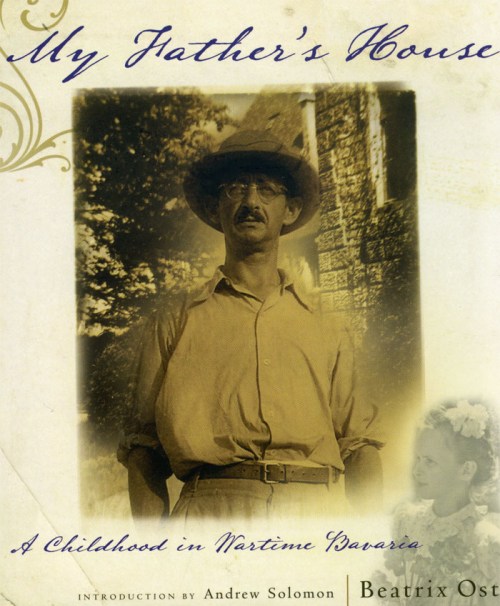
“My Father’s House” is unusual in many ways. It is an honest and loving portrait of the author’s father, beautifully written, that provides a unique window into Nazi Germany. The book is made up of numerous vivid details such as this passage:
Once, my parents had lived a truly magical life. In the early years of their marriage, between the wars, they lived with their friend Baron Wilhelm Farnbühler at his castle near Stuttgart. The Baron had his own wing; my parents, with Uli and Anita, had theirs. In the great hall, in a cage, there dwelt an owl, who preferred to eat living things: rabbits and mice. His lame wing folded into a crutch, he shrieked into the night and rattled the bars.
I simply happened upon the life and work of Beatrix Ost while in the process of exploring. It began while I was doing some research for a book review of, “Jerusalem,” a graphic novel that relates to the creation of the State of Israel. I had also just written a movie review of a documentary, “The Flat,” about the unusual relationship between a Jewish couple, who had emigrated to Palestine during World War II, and maintained a friendship, after the war, with a high ranking Nazi official. Life is complicated. Things are never quite as they seem. In the case of Beatrix Ost, this is an enormously talented person: writer, artist, desginer, actor, and theatrical producer. She is what she appears to be and so much more.
Beatrix Ost comes from a world of the rich, those F. Scott Fitzgerald has noted as “different from you and me.” Ost is not here to deny the world she was born into. She was born in 1940, in the castle from the above passage. However, given this difference or distinction, Ost finds a way for you to join in. It is, in fact, a world not so different from you and me. It is far more earthy and raw than you may imagine.
This may sound trite, but many readers may relate to the stories presented here if they think of the landmark musical, “The Sound of Music.” As jarring as it is to juxtapose Nazis with Bavarian folklife, general audiences understand, in the context of the musical, how two Germanys could coexist: one run by Hitler and another very different one. It takes a strength and boldness to be able to bring out a multitude of memories that are innocent and sweet amid a backdrop of war. Ost engages the reader on a Proustian level, never missing a beat of recovered memory and dipping deep into a well of language that consistently produces gems.
Think of this book as a collection of passages that, as a whole, bring out a greater truth. Each passage is like a little story of its own. Consider this passage from “The Gleaners,” describing people during World War II coming to the Ost family farm in search of food. They would come in search of even the smallest potato. Dieter, a member of the household staff would be dispatched to fetch a bunch of the teenaged girls from the girls school to help themselves to potatoes. They arrived in what they could muster up for the latest fashion, all hardened by the war but joyful:
The girls trudged along behind the plow, collecting potatoes in sacks. When the sacks were full, they were tipped into a cart. It started to rain. The girls sought shelter under the one available roof: the potato wagon. But the rain got through between the narrow planks, and after a short while, they were drenched. Their cheap dresses rode up above their knees, clinging to their thin bodies. Little rivulets of color ran down their legs.
It is Ost’s father, Fritz, who looms larger than life over this landscape of memory. He did his military service in Africa and subsequently retired, including his membership in the Nazi party. He had only belonged to the party to help his friends, particularly his Jewish friends, secure safe passage out of the country. He was a proud man that seemed to only want to be left alone to rule over his estate, Goldachhof, a rural paradise of manor, farm and stables, about twenty miles out of Munich. If there were Nazis amidst the circles he travelled in, he didn’t want to know. What he, and his wife, Adi, did know was to help those in need and Goldachhof proved a haven for refuges many times over. It is this backdrop that little Beatrix grew up in and learned the ways of the world, from getting by on rations to celebrating the dawn of a new world ushered in by the Americans.
This excerpt gives you a taste of the exuberance of youth faced with big change. The Americans, all brash and exciting, had finally arrived. But they make a few missteps. A couple of homesick Texans decide to ride a couple of the carriage horses, who were not meant for riding. Then some soldiers got the nutty idea of going fishing with hand grenades. This was far too much for Herr Ost and he finally managed to restore order by bringing in a high ranking American officer to have a talk with his men. But change had arrived and there was no turning back:
Now we children played Yank all winter long as we sledded down the granary path on our Jeeps. We still had our “Judenstrick,” ersatz cigarettes made from the winter-dried marrow of elderberry twigs, but we were infatuated with everything the Americans brought into our little world. They had landed among us with the exciting utensils of their exotic culture. Chewing gum. Nescafe. Powdered milk. Hershey’s chocolate. Blue jeans. Johnson’s lotion. Marlboros. Things useful and also symbols of hope, the end of terror. Our blue days were gone–love live The Blues.

How such a book came into being is remarkable. “My Father’s House” is an inspiring and enlightening work. It can be appreciated on many levels, not the least of which is in the classroom. You can purchase it here.
Like this:
Like Loading...





KICKSTARTER: A NIGHT AT THE SORRENTO at 30 Percent Support
A NIGHT AT THE SORRENTO AND OTHER STORIES is a quirky batch of comics that is steadily gaining ground as the subject of a fundraising campaign at Kickstarter. It launched on April 3 and has reached the 30 percent mark in pledges. The campaign runs through May 6. You can view it HERE.
Now, here’s the thing about this one, it has a raw honesty to it that it shares with other Generation X artists. That’s where this artist, Henry Chamberlain, dates back to. That sort of blunt honesty has been refined over the years although an outsider’s view still remains. Think of Charles Burns, for example: acerbic, alienated, yet very heartfelt and authentic. You can find that in this collection of comics. That’s important to bring out here because this book includes the graphic novel, ALICE IN NEW YORK, which is an older work and very much aligned to that spirit. The other part of the book collects recent work, done in the last three years, that originated with 24-Hour Comics challenges. Altogether, you get one artist’s vision over a span of many years.
So, let’s focus in with a few more words about the graphic novel, “Alice in New York” that is part of this collection. What makes it share a Gen X sensibility has to do with the main character’s feeling of being at a loss. For many of a creative and intellectual bent, it just felt like we were in for a long stretch of lowered expectations. Sure, that’s pretty shortsighted. But, growing up in the ’80s, with Reagan and Thatcher running the show, with the Baby Boomers having hogged the spotlight for so long, with a perpetual rehash of pop culture, it didn’t look so good. Of course, we all knew things would change one way or another but it fostered a healthy sense of cynicism and self-deprecation.
You have the main character, Henry, a young man on his first visit to New York City still holding on to dreams of previous generations, from the myth of the Great American Novel to the lure of fifteen minutes of fame. Is it any wonder the boy is a wreck? But, he stumbles upon just the right circumstances and meets the right people to help him out. Is he too lucky? Well, sometimes you make the most of what you get, create your own luck. Add to that a little magic from Alice in Wonderland, and you have a story that transcends any generation which is what you want to do in the end!
Generation X’s way of life is not for everyone. You basically had to be there. Just saying that is so Gen X. If you’re looking for something to read that is a voice of a generation, while stubbornly refusing to be labeled, and ending up being so much more, then check out this work at Kickstarter HERE.
Share this:
Like this:
Leave a comment
Filed under Art, Books, Comics, Comix, Culture, Generation X, Kickstarter, New York City, pop culture
Tagged as 24 Hour Comics Day, andy warhol, Art, Books, comics, Entertainment, Generation X, Great American Novel, Kickstarter, New York City, Pop Culture, Social Commentary