Category Archives: science fiction

Interview: William F. Nolan and the True Meaning of Fiction

William F. Nolan and Ray Bradbury

William F. Nolan and Ray Bradbury

Great fiction comes from all over: horror, dark fantasy, mystery, and so on. William F. Nolan writes in various genres. You may know him from his work with Dan Curtis, such as the classic horror film, “Burnt Offerings.” Or perhaps you know him from co-writing, with George Clayton Johnson, the classic dystopian novel, “Logan’s Run.” Mr. Nolan has gained great recognition and won numerous awards and honors. Just last year he was named the Grand Master at the World Horror Convention in Atlanta. In this interview, we spend a good time chatting about horror as well as fiction in general. And we definitely visit the subject of the Southern California Sorcerers, otherwise known simply as The Group.

"Burnt Offerings" from 1976

“Burnt Offerings” from 1976

During our conversation, Bill shared a very special moment regarding his friend and fellow writer, George Clayton Johnson, who passed away this last Christmas. He offers up for us a picture of a fresh-faced, and beaming, young George bursting upon the scene, circa 1957. He has shown up at a meeting of The Group and asks if he may join in with the illustrious and ambitious writers. Someone asks George what he has to show for himself. And, George, just having received his box of author copies, proudly shows the men what he’s been up to. “Hey guys,” George says, “I co-wrote this really cool thing called, ‘Ocean’s Eleven!'” And the rest is history!

This interview was conducted Monday, February 22nd. William F. Nolan is going strong, just shy of his 88th birthday on March 6th. If you love a good story, or if you are an aspiring writer yourself, or if you’d like to know something about the Sixties zeitgeist, then this interview is for you. In the span of about twenty minutes we cover a lifetime of observations and insight.

Henry Chamberlain: Thank you for getting together with me, Bill. I wanted to cover the writer’s life with you in this interview. First off, a good horror story has been compared to placing a frog in gradually boiling water. What can you tell us about the boiled frog method of storytelling?

William F. Nolan: Allow me to veer off a bit from the boiled frog to tell you how I approach telling a story. Really, how I tell a story is like the other night when I was in bed, half asleep and half awake, a state where I get all of my ideas. I was thinking of these deadly flowers. They had the power to stop the human heart. They were alive and, if you didn’t treat them right, they could turn against and stop your heart. There’s this couple who decide to rent this place on the beach. It looks like a great place. The owner lets them know that they have to take care of these special flowers but the couple ignore him, they don’t do it. And they end up being killed by the flowers. Their dead bodies are found on the beach. That’s how I form an idea for a story. I get an opening in my head for the concept and then I get the ending. Finally, I fill in the middle. That’s how I write a horror story, or any other kind of story.

Discoveries Best of Horror and Dark Fantasy edited by James R. Beach and Jason V Brock

Discoveries Best of Horror and Dark Fantasy edited by James R. Beach and Jason V Brock

HC: There’s a story of yours, “Stabbed by Rob,” in the recently published collection of dark fantasy from Dark Discoveries, edited by James R Beach and Jason V Brock. That story is a perfect example of that boiled frog method. There are a number of touches of humor, including your mentioning a glow-in-the-dark statue of Jesus. And the story keeps turning up the heat to the very last sentence.

WFN: Well, I believe you really can’t get away without some humor in a horror story. Horror is too stark, raw, and unflinching. You need to be able to live in it. You’ve got to lighten it with some humor. All my horror stories have elements of humor. You need to let the reader breathe. You can’t go from the first page to the last and do straight horror. That’s the problem with H. P. Lovecraft for me. Lovecraft has no sense of humor. He was a brilliant writer. He was a brilliant innovator. But no sense of humor. By the time you finish “The Shadow over Innsmouth,” you’re exhausted. I want my readers to relax a little, to breathe, and have a good chuckle while they’re being frightened. That’s my method of writing horror.

HC: I’m glad that you mention Lovecraft because I’ve had difficulty with him too. Your adaptation with Dan Curtis of Robert Marasco’s 1973 novel, “Burnt Offerings,” has just the right touches of humor at the start, and they give way to a more sinister mood. There’s a balance.

WFN: Yes, that was adapted from the Marasco novel which had no humor whatsoever. I told Dan Curtis, who directed, and produced the film with me, that we were going to need to lighten up the material because it was too stark. I’m glad that you appreciate the humorous elements in the film. As I say, I just don’t think you can do horror without lightening it up a little bit.

HC: Then there’s Ray Russell’s work. Perhaps more of a touch of elegance than humor. I love the way Ray Russell masterfully brings up a lot of pretty grim stuff in his work. He knows what to leave in and what to mostly imply. I’m thinking of “Sardonicus,” “Sagittarius,” and “Sanguinarius.”

WFN: Ray Russell was one of my closest friends for years. We would talk about how to write in terms of horror. And we both agreed on the same thing that you’ve got to put some humor into it in order to lighten the whole thing. I love Ray’s work. He passed on some years back. He would be happy to hear that you enjoy his work.

Just Part of The Group: Charles Fritch, Chad Oliver, Charles Beaumont, Richard Matheson, and William F. Nolan, circa 1954.

Just Part of The Group: Charles Fritch, Chad Oliver, Charles Beaumont, Richard Matheson, and William F. Nolan, circa 1954.

HC: There were all of these amazing writers that you got to be close with in social settings and in work sessions. All of you together were the Southern California Writer’s Group.

WFN: There were eleven of us. We didn’t think of ourselves as anything special. We were all trying to make a living, pay the rent, pay the mortgage, stay afloat. We wrote science fiction and fantasy in a modern vein. We took it away from the Lovecraftian type of fiction and wrote a modern type. It was sort of pioneered by Richard Matheson and Ray Bradbury who were part of our group. We all worked from the same principle: you can do modern horror but it has got to be something that people can believe in. It has to be realistic. It should happen today, in somebody’s kitchen. It could happen in a kitchen. You don’t have to go to a haunted castle, back in Transylvania, to have horror. Horror can happen on your doorstep. Horror can be a terrorist with a submachine gun that sprays lead over you while you’re eating in a restaurant. That’s horror. Horror takes many forms. We all tried to work within that scope.

Yeah, eleven of us. Matheson, Bradbury, myself…Charles Beaumont was sort of the hub of the thing. We had Jerry Sohl. We had Robert Bloch, known for “Psycho.” We’d all gather together at each other’s houses, at all-night coffeeshops and talk shop, editors, and markets. We were quite a group. All these years later, people look back on us as pioneers in the field. And that’s nice but, at the time, we were just trying to make a buck, just trying to make a living.

HC: Well, sure, you guys were so close to it all. You would need to stand back to see it clearly. What you guys did was take gothic literature and give it a modern cool. That’s essentially it.

I AM LEGEND by Richard Matheson

I AM LEGEND by Richard Matheson

WFN: Yeah. I still think that you can credit Richard Matheson for a lot of that. Stephen King said that he was influenced more by Richard Matheson, than any other author, because he took horror out of the castle and brought it into the kitchen. And I agree with him. We all tried to do that. We all felt that was the way to go. We weren’t interested in something ancient. We wanted something real, something of today.

HC: You list eleven members of The Group. Was there any time that all eleven of you met under one roof?

WFN: Three or four of us were into auto racing. Richard Matheson, Jerry Sohl, and Robert Bloch didn’t care at all about that. But Charles Beaumont, John Tomerlin, and myself were heavily into Grand Prix sports car racing both here and in Europe. We actually flew to Monte Carlo one year for the Grand Prix. And we went to Sebring Raceway in Florida for the races there. The Beaumont kitchen in North Hollywood, his upstairs kitchen, is where most of us would meet. George Clayton Johnson was part of that group too. We would meet there. But there was never a meeting of all eleven of us at one time. It was three or four of us at at time at different places. We’d go to movies together. We’d meet in coffeeshops.

Musso and Frank Grill

Musso and Frank Grill

HC: I imagine that you guys enjoyed Musso and Frank Grill.

WFN: We loved Musso and Frank Grill. It has all that history: Hemingway, Fitzgerald, and William Faulkner. The murals never changed. The seats are the same. When you’re sitting there, it’s like you’ve gone back in a time machine. We loved it. I still love it. I love to go whenever I’m in L.A.

HC: You touched upon George. I have to say that I can imagine that he loved the fact that he got to pass away on Christmas Day. Such a magical thing. Such an act of will.

WFN: That was no accident. He was ill. He was in hospice care for about a week before that happened.

HC: Oh, yeah.

WFN: The doctors were saying that he could go at any minute but George, subconsciously, since he couldn’t verbalize it at that stage, was saying that the doctors couldn’t tell him when he was going to die. He was always an independent guy. He was saying: “I want to die on Christmas Day since that was the birthday of Rod Serling, who made me famous for my writing for The Twilight Zone.” He was able to die three days past when he was expected to die. He was able to fool all the doctors. That was no accident.

George Clayton Johnson and William F. Nolan, circa 1957

George Clayton Johnson and William F. Nolan, circa 1957, illustration by Henry Chamberlain

HC: Yes, that’s what I meant. I was honored to interview George a number of times and got to meet him in person. Would you share with us a little more of the flavor of the era and a picture of George at one of these bull sessions at The Group that may come to mind?

WFN: Four or five of us were sitting in the living room of the upstairs apartment of Charles Beaumont one night. There was a knock at the door. This is around 1957. The Group was around from the ’50s to ’60s. So, there’s a knock at the door. We open the door and there’s George Clayton Johnson with a package under his arm. He said, “I’m George Clayton Johnson. I want to join you guys. I want to be with you. I’ve heard about you and I want to join you.” Someone asked, “Are you a writer?” He said, “Yes, I am,” and he held up the package, “It’s called, ‘Ocean’s Eleven’ and I just sold it to Frank Sinatra!” That’s what got him started with The Group.

HC: That’s beautiful. I wanted to ask you about the literary tradition that The Group worked from. I’m sure that Nathaniel Hawthorne, Mary Shelly, all the gothic writers, were subjects of conversations for all of you.

WFN: You can’t write out of a vacuum. We’re all influenced by other people. Ray Bradbury was influenced by Herman Melville, William Shakespeare, and George Bernard Shaw. We were influenced more by such horror writers as Arthur Machen and Algernon Blackwood. I started out reading H.G. Wells’s “The Time Machine” and “War of the Worlds” when I was a boy growing up in Kansas City, Missouri. And then I discovered Bradbury and Weird Tales. Ray Bradbury and I became close friends and that lasted 50 years. We’re all standing on the shoulders of other people. We all read Hawthorne and Robert Louis Stevenson. We were influenced by them but we wanted to take our fiction into a modern setting and move it forward and I believe we succeeded.

Photo by Ralph Morris, Hollywood Blvd. 1960

Photo by Ralph Morris, Hollywood Blvd. 1960

HC: I wanted to close out by asking if you could give us a little more of a flavor of Los Angeles in the ’50s and ’60s. I can just imagine: you had the ghost of Raymond Chandler; old Hollywood giving way to new Hollywood; Forey Ackerman and the rise of geek culture. L.A. in the Sixties, it doesn’t get much better than that.

WFN: I read Raymond Chandler, Dashiell Hammett, the hard-boiled school, James M. Cain. I’ve read books on Chandler and Hammett. I’m a big hard-boiled fan. Los Angeles was a hard-boiled city in those days. Dashiell Hammett glorified San Francisco. But Los Angeles was also part of that era where corruption ruled in high places. It was a violent and colorful era captured beautifully by Raymond Chandler. If you read the work of Raymond Chandler, you’re learning a lot about Los Angeles as he experienced it.

I can tell you that there was a lot of smog. I used to live in Burbank, right against the mountains. The smog was terrible. I did move around different parts of Los Angeles. It changed quite a lot during the many years I was there. It’s not the same city that it used to be.

HC: I love Los Angeles and love looking for signs of yesteryear. They’re around if you know where to look for them.

WFN: If you go to Pasadena, there’s the old bridge that Raymond Chandler wrote about in one of his novels. The bridge that Philip Marlowe drove over at night. It’s still standing there. I wrote a piece entitled, “Marlowe in Los Angeles.” I toured all the places he used to go to, including Musso and Frank Grill. Chandler was an insatiable researcher, always moving around, and usually within the greater Los Angeles area. He grew to know it beautifully. Hammett made San Francisco famous with “The Maltese Falcon.” Chandler did the same for Los Angeles with “The Big Sleep.”

HC: I wish you a great year ahead, Bill. Any projects we can look forward to soon?

WFN: I had a collection of my poetry come out last year. This year we’ll have a new collection of my essays. I’m working on a new collection of short stories. I just wrote three new stories this month. So, even though I’ll be turning 88, I feel like I’m still 28.

HC: I can feel the energy. Thanks again, Bill.

WFN: I really enjoyed this. Thank you.

You can listen to the podcast interview by just clicking the link below:

Keep up with William F. Nolan at his website right here.

6 Comments

Filed under Charles Beaumont, George Clayton Johnson, Interviews, Jason V. Brock, Richard Matheson, Rod Serling, Sci-Fi, science fiction, The Twilight Zone, William F. Nolan, writers, writing

Review: ‘Reading Richard Matheson: A Critical Survey’

"I Am Legend" by Richard Matheson

“I Am Legend” by Richard Matheson. Illustration by Henry Chamberlain.

The work of Richard Matheson (1926-2013) is certainly suitable for in-depth analysis. It is through an academic lens that you can plumb such insights as the one about the recurring nemesis in Matheson’s groundbreaking novel, “I Am Legend.” As Charles Hoge describes, in this first survey of its kind, the neighbor-turned-vampire who repeatedly taunts the protagonist is part of a literary tradition dating back hundreds of years. Instead of being hidden away in Bavarian castles, vampires were known to call out their victims from their own village. It is a simple distinction like that which Matheson runs with to create one of the most influential books in pop culture.

It was this seismic shift from monsters in castles to monsters in the suburbs that would change everything and influence everyone from George Romero to Stephen King. Yes, you can thank Richard Matheson for the zombie apocalypse. He essentially invented it with his 1954 horror novel, “I Am Legend.” Well, there’s more to it. And you can dig deeper in this first ever substantial study, “Reading Richard Matheson: A Critical Survey,” edited by Cheyenne Mathews and Janet V. Haedicke, published by Rowman & Littlefield.

The original “I Am Legend” novel is an elegant and tightly written work. Our protagonist, Robert Neville, must figure out, with Sherlockian exactitude, what has brought about a world-wide pandemic of vampires. It is a prime example of work from the first phase of Matheson’s career. The theme here is man as victim of his own environment. By the time of Matheson’s work on the landmark television series, The Twilight Zone, his theme has broadened to man as victim of his own making. Within these two themes, a multitude of work can be examined. It is with this survey that we receive an essential collection of serious thought on a writer who Stephen King has ranked with Poe and Lovecraft.

In a piece that focuses on the noir character of The Twilight Zone, Cheyenne Mathews demonstrates both Matheson’s artistry and how well The Twilight Zone holds up to critical scrutiny. Cheyenne writes: “Through science fiction tropes of time travel, alternate realities, and new technologies, Matheson emphasizes the physical and social displacement that afflicted both men and women during the attempted postwar return to normality.” And, in describing what is considered the most noir Twilight Zone episode, “Night Call,” Mathews writes: “The second act of the episode conflates Elva’s personal anxieties with her social alienation, as she becomes increasingly disconnected from the other characters, who attempt to downplay her distress.” Of course, there is Matheson’s most celebrated TZ episode, “Nightmare at 20,000 Feet,” but, as Mathews makes clear, it is part of a bigger picture. Outside of Rod Serling, who wrote the majority of scripts, Matheson wrote the most episodes and they were all gems.

A man of his time, and ahead of his time, Richard Matheson has secured a place for himself within not only great science fiction, horror, and fantasy, but great fiction in general. Ultimately, Matheson’s work strikes a universal chord. We can explore the specific era he worked in and how he spoke to concerns of postwar paranoia and shifting gender roles; and, like Kafka, we can place him within some of the most eloquent writers on the human condition. Matheson was weary of being labeled a genre writer. Perhaps one of his fellow writers and friends, George Clayton Johnson, summed it up best when he said of Matheson that he was one of the “serious storytellers whose works were artful gems of wisdom fiction.”

“Reading Richard Matheson: A Critical Survey” is essential reading for anyone interested in understanding the origins of today’s pop culture at a deeper level and gaining a greater appreciation of the work of Richard Matheson.

Richard-Matheson-Twilight-Zone

“Reading Richard Matheson: A Critical Survey” is a 262-page hardcover published by Rowman & Littlefield.

8 Comments

Filed under fantasy, George Clayton Johnson, Horror, Richard Matheson, Rowman & Littlefield, Sci-Fi, science fiction, The Twilight Zone

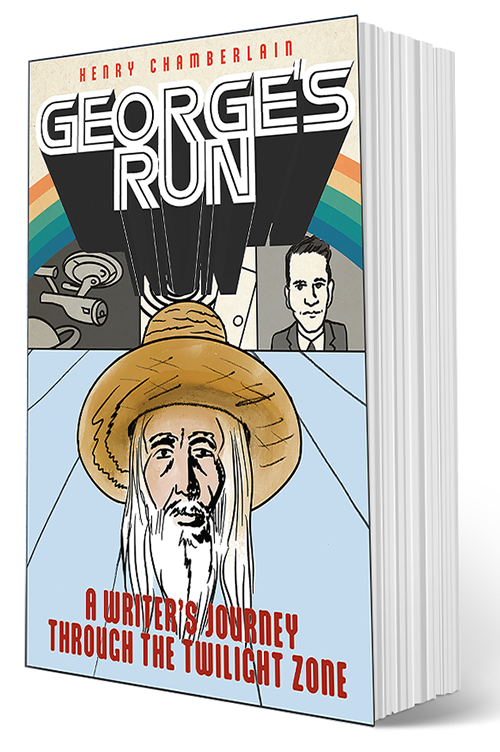
Short Run 2015: Debut of GEORGE’S RUN #1

First issue of George's Run to debut at Short Run

First issue of George’s Run to debut at Short Run

For all of us in the comics community, whether creators or fans, it is time once again for the Short Run Comix & Arts Festival. There’s a nice write-up about it in the local alt-weekly, The Stranger, that you can check out here. Among a splendid array of comics that you will have a chance to choose from, I humbly add something I am working on. This is the first installment to a full-length work. It’s called, “George’s Run,” and it’s about the life and times of science fiction writer George Clayton Johnson. I am still in the process of weaving the narrative but this is a perfect time to share some of what I’ve put together thus far. If you happen to go to Short Run, you’ll have a chance to buy a copy of this 24-page comic. You can find me at the Short Run tables under the name, Comics Grinder Press.

Short Run Comix & Arts Festival takes place this Halloween: Saturday, October 31, in Fisher Pavilion at Seattle Center from 11 am to 6 pm.

For more details, be sure to visit our friends at Short Run right here.

5 Comments

Filed under Alternative Comics, Comic Arts Festivals, Comics, Comix, George Clayton Johnson, Independent Comics, Indie, mini-comics, Minicomics, Sci-Fi, science fiction, Seattle, Self-Published, Short Run

Review: TITAN #1 & #2

Phoebe at rest, one of the Titan masses.

Phoebe at rest, one of the Titan masses.

François Vigneault is an impressive cartoonist and I am so glad to share his work with you here at Comics Grinder. Phoebe and João come from two extremes on the class spectrum but they can’t help but be attracted to each other in François Vigneault’s TITAN, a new quirky sci-fi comics series published by Study Group Comics as a webcomic and as printed issues too.

Phoebe and João in François Vigneault's TITAN, published by Study Group Comics

Phoebe and João in François Vigneault’s TITAN, published by Study Group Comics

You’ve heard of the One Percenters, right? And all the economic disparity? Ha, of course you have. Ah, yes, the haves vs. the have-nots theme. In TITAN, the haves are Terrans and the have-nots are Titans. Vigneault brings us aboard Homestead Station on the moon of Titan where we follow Manager João da Silva as he attempts to lessen tensions between the geneticly-engineered Titan workers and the Terran management. It turns out that the key to his problems lies with one voluptuous Titan worker, Phoebe.

The dynamics on Homestead Station is a lot of fun to see unfold in these first two issues. Far, far, away, in some distant future, you’ll find that crass youth haven’t really changed much at all. Slang, for instance, reflects the latest level of rage. Communication in general, particularly amongst the working class, has undergone a further breakdown in literacy as everyone speaks in choppy sentences. It’s a grim world just waiting to explode! Vigneault keeps our eyes moving with just the right touches of futuristic background and engaging facial expressions and body language. TITAN proves to be a comic in the best sci-fi tradition: a compelling exploration of the human psyche.

Phoebe can't help but tower over Joao.

Phoebe can’t help but tower over João.

The relationship between Phoebe and João is very intriguing. Vigneault does a great job in expressing the divide between rich and poor, the vulnerabilities on each side. Vigneault engages the reader with a love story every bit unlikely and yet most compelling. Phoebe, who would seem to have the disadvantage as a member of the working class, cannot help but tower over her would-be master, João. And João seems to like it.

Study-Group-Comics-Titan-2105

If you’re heading out to the Small Press Expo, taking place this weekend in Bethesda, Maryland, you’ll be seeing some of the best independent comics around. SPX is turning 21 this year, by the way, which makes her legal. Anyway, TITAN #2 will debut at SPX and is surely a comic you’ll want to pick up. Be sure to visit François Vigneault at the Floating World Comics/Study Group table, J8-9.

Small-Press-Expo-2015

For more on the Small Press Expo, visit right here. And keep up with TITAN and Study Group Comics right here.

Leave a comment

Filed under Alternative Comics, Comic Arts Festivals, Comics, Independent Comics, Indie, Sci-Fi, science fiction, Small Press Expo, SPX, Study Group Comics

Review: INTRO TO ALIEN INVASION

Intro-to-Alien-Invasion-Scribner-2015

“Intro to Alien Invasion,” published by Scribner, an imprint of Simon & Schuster, is a cheeky story about what happens when extraterrestrials take over a secluded liberal arts college nestled in the Vermont hills. All is not quiet and mellow at Fenton College once the biggest life lesson of all opens the eyes, and tears the limbs off, a bunch of sheltered and pampered brats.

Member of the library staff caught in sheer terror.

Member of the library staff caught in sheer terror.

In the same spirit as “Rushmore” and “Animal House,” it’s the exceptions to the rule, the small fringe element of misfit students, that will prove their mettle and perhaps save everyone else’s sorry asses. This very funny graphic novel has some great talent behind it. Owen King is author of the novel, “Double Feature.” And Mark Jude Poirier is the screenwriter of the 2013 film, “Hateship Loveship,” starring Kristen Wig. The artwork is by newcomer Nancy Ahn.

Nancy-Ahn-Intro-to-Alien-Invasion

Much of the story revolves around nerdy and mousy Stacey, an otherwise brilliant mind, who is vulnerable beyond measure. Bumbling Professor Evans, plans to exploit his status as an expert in astrobiology, and lure Stacey into his snare. And then there’s a huge change in plan. Something that the professor smuggled back from Siberia has come to life.

The story will bog down a bit when it gets to a lot of explaining as to the what and the why about goopy things running amok on campus. Really, at some point, nobody cares anymore and have settled in for a gross-out yuck-fest which this book happily provides. That said, these asides don’t ever last too long and, in the spirit of Lisa Simpson, are edifying in their own weird way. There are times too when Ahn’s loose style will get rather too loose and slack. That can be attributed to some extent to the easygoing, and unconventional, narrative. Honestly, I’m not sure if I’d want this book done any other way considering the offbeat vision.

As it seems to be de rigueur in even the most crass humor, a tender thoroughly sensitive love story is included here. It proves to give an overall nice balance to the belly laughs and/or mild amusement you’ll find here depending upon your temperament. It’s a credit to the writing that it actually does work. You have characters here that you grow to care about. It’s not just Stacey and some creepy prof but all of Stacey’s friends and frenemies. At the end of the day, this is a fun book and will appeal to a lot people, like fans of “The Simpsons” and “Adventure Time,” which is, at last count, a whole lot of people. “Intro to Alien Invasion” is a 224-page black & white trade paperback, available as of September 15th. You can find it at Amazon right here. Visit our friends at Simon & Schuster right here.

2 Comments

Filed under Comics, Graphic Novel Reviews, graphic novels, Satire, Sci-Fi, science fiction

Book Review: WE INSTALL and Other Stories by Harry Turtledove

Miss Murple astride a caitnop.

Miss Murple astride a caitnop. Illustration by Henry Chamberlain.

“We Install and Other Stories” offers up an impressive showcase of the work of Harry Turtledove, known for his virtuoso writing of alternate history novels. Among all the gems in this 282-page collection of fiction and essays, the one that stole my heart is “Hoxbomb” for its quirky storytelling. It grabbed me right from the start like a cross between “The Wizard of Oz” and “Blade Runner.”

“Hoxbomb” is a sci-fi police procedural and a study in race relations: the Humans and the Snarre’t. We find ourselves a hundred or so years in the future with two competing species who must make nice for the sake of their own survival. Humans and Snarre’t must work together as they colonize Lacanth C, a new planet and a new lease on life for both races. Much like “In the Heat of the Night,” tensions run high but differences must be set aside for the greater good of solving the case of a heinous crime.

That’s really easier said than done since the Snarre’t are so different from Humans. Of course, that begs the question, Are they really That different? Well, yeah, they are. For one thing, there’s a huge difference in technology: Humans favor machines; Snarre’t favor biotech. There’s also a war of the senses: Humans rely upon sight and sound; Snarre’t rely upon smell. And Snarre’t ride strange animals instead of motorized vehicles and enjoy eating the excrement from these animals.

However, Snarre’t prove to be just as capable of being star-struck as Humans. They are also as gullible and prone to being manipulated by the media. When you really think about it, the Snarre’t aren’t that different from their Human counterparts. It’s something that becomes more apparent to the two detectives from opposing races during the course of this story: The Humans’ John Paul King and the Snarre’t’s Miss Murple make for very entertaining frenemies. This fiction is very much at home with other works in this book. There’s a jokey and sentimental quality tempered with just the right amount of thoughtful contemplation.

“We Install” proves to be a great introduction to Harry Turtledove, full of humor and rich in historical and philosophical musing. “We Install” is available as of August 25th and is published by Open Road Integrated Media where you’ll want to check out their Hugo Award Collection right here. You can also find “We Install” at Amazon right here.

4 Comments

Filed under Amazon, Book Reviews, Books, Harry Turtledove, Hugo Award, Open Road Integrated Media, science fiction

Kickstarter: VOYAGER – A Sci-Fi Series Based On Events From A Near Future

Voyager-sci-fi-tv-show

The most innovative and realistic TV series about space exploration and extra-terrestrial life – because we want to believe.

Check out a most deserving Kickstarter campaign. VOYAGER is a new breed of sci-fi television set in the present day and using real science.

VOYAGER is also new in that it welcomes your input. It has launched as of today, August 8th. Visit the campaign right here.

So real, it will inspire your belief in sci-fi. It is also the first network-bound narrative TV series to welcome crowdsourcing and fan endorsement at the most strategic and determining stage of its development.

Among many compelling elements to this show, the connection to science fiction and real science is very appealing. Have you read about the possibility of finding life on Europa, one of Jupiter’s moons? That is one of the missions that VOYAGER will take on.

Similar to how adventurers of yesteryear once sailed the seas or took to the skies in search of the unknown, the show follows a group of unique and conflicted characters, including beings of artificial intelligence, all led by an eccentric and daring Russian billionairess, as they explore new worlds and weird, terrifying reality.

VOYAGER is co-created and written by Richard Christian Matheson, son of legendary writer Richard Matheson, and a master of horror and science fiction in his own right. If you are looking for the next exciting sci-fi tv show, consider VOYAGER and visit their Kickstarter campaign going on thru September 12th, right here.

2 Comments

Filed under Kickstarter, Richard Matheson, Sci-Fi, science fiction, Television

Sci-Fi Focus: THE SHAMAN to Show at Hollyshorts, Portland Film Festival, and Dragon Con

Shaman-Marco-Kalantari

If you’re looking for new talent on the rise that offers the next wave of sci-fi action movie adventure, then look to director Marco Kalantari’s short film, “The Shaman.” It is a pleasure to have at Comics Grinder an interview with Mr. Kalantari, which you can listen to here. And Comics Grinder has an exclusive manga adaptation to his short work as well as a review, which you can view here. This is a short film with promises of bigger things to come. It is definitely a look at what a visionary director can offer.

The-Shaman-film-2015

THE SHAMAN premiered at the 2015 Tribeca Film Festival. And that resulted in Kalantari being signed by UTA. The film will be playing in the upcoming Hollyshorts Film Festival in LA as well as at the Dragon Con Independent Film Festival in Atlanta and in the Portland Film Festival.

The-Shaman-movie

If you’re in the area, go see THE SHAMAN:

Hollyshorts Film Festival in Los Angeles runs from August 13-22

Portland Film Festival runs September 1-7

Dragon Con Independent Film Festival in Atlanta runs September 4-7

Here is a synopsis of THE SHAMAN:

The dark year 2204, in a world that has seen 73 years of continuous war.

The face of conflict has changed. People kill people but they now rely on giant, intelligent battle machines to fight. Meanwhile, mankind has re-discovered the arts of magic and Shamanism and the Generals on both sides use well-trained spiritual warriors to face the threat of machines. Shamans have special senses; they are experts in all aspects of the “unseen” and the “beyond”. They believe that every person, animal, plant and object has a soul. When crossing the border to the Netherworld, the Shaman can find this soul and interact with it. That is what makes him such a deadly, highly effective weapon. They track and convert the souls of their enemies’ giant battle machines in a psychological soul-to-soul confrontation. But Shamans are not invulnerable. They are just people and can be killed like anyone else.

Shaman Joshua Van Kern and his squire Lene embark on a mission to convert a giant battle colossus and succeed where troops have failed.

And you can always visit the director’s website right here.

Leave a comment

Filed under Film Festivals, Filmmaking, Marco Kalantari, movies, Sci-Fi, science fiction

Logan’s Run: Vintage Movie Classics (A Vintage Movie Classic) Release Date – July 7, 2015

Logans-Run-Vintage-Books-2015

The new print and ebook edition of the original novel, “Logan’s Run,” by George Clayton Johnson and William F. Nolan, is now out, published by Vintage Books, a division of Penguin Random House. Check out the new line of Vintage Movie Classics right here. This is the bestselling dystopian novel that inspired the 1970s science-fiction classic starring Michael York, Jenny Agutter, and Richard Jordan. For many of you out there, enough said. It will instantly bring to mind crystal palm flowers flickering red. If that means nothing to you, then you’re in for a treat. Perhaps knowing that such works as “The Hunger Games” and the Divergent trilogy owe much to this novel with pique your interest.

It is a beautiful new edition for longtime fans and newcomers alike. For the longest time, this title was essentially out of print, as far as a mass market printing was concerned. The original novel was a huge hit in its day, only to be magnified by its tie-in with the major motion picture. The novel was never forgotten and, in fact, its legend grew. Special edition print runs came out over the years and you could always find an old copy of the many editions that exist. For collectors, there are many iconic paperback editions to choose from. But the fact remained that the time had come for a new readily available edition and now we have it. I’ve been a big supporter of bringing out a new edition. You can read my review of the original novel and my call for a new edition right here.

The forward is by Daniel H. Wilson, author of several books on possible dystopian futures, including Where’s My Jetpack?, Robogenesis, and the forthcoming, Quarantine Zone. Wilson provides just the right balance of looking back to his own childhood experience with Logan’s Run and observations on the novel’s enduring relevance. Wilson’s enthusiasm for his subject is infectious and adds a contemporary boost to a timeless classic.

The novel, first published in 1967, paints a very compelling, and alarming, picture of a society overly dependent upon technology for all aspects of life. Youth has been conditioned to seek out distraction and pleasure over all else, including quality of life. That said, for anyone familiar with the movie, this is also one very entertaining story. The movie echoes the novel as it veers off into its own high level of kitsch. But no harm done. The movie remains a cult classic and an excellent gateway to the original novel.

I have always held a fascination with how movies adapt novels so I am thrilled to discover Logan’s Run is part of a new line of books from Vintage Books. Vintage Movie Classics includes a wide variety titles like “Night of the Hunter,” the bestselling National Book Award-finalist that inspired Charles Laughton’s expressionist horror classic starring Robert Mitchum and Shelly Winters. Other available titles: The Bad Seed, The Bitter Tea of General Yen, Back Street, Alice Adams, Show Boat, and The Ghost and Mrs. Muir. This is truly astounding for the broad range and the opportunity to rediscover lost gems.

You can find Logan’s Run over at Vintage Books right here and over at Amazon right here.

2 Comments

Filed under Books, George Clayton Johnson, Logan's Run, Novels, pop culture, science fiction, William F. Nolan

Movie Review: ‘Ex Machina’

Ex-Machina-Alex-Garland-2015

Mary Shelly’s “Frankenstein, or, The Modern Prometheus,” first published in 1818, is as fresh as a daisy in “Ex Machina,” the new film written and directed by Alex Garland. This is Frankenstein’s monster if it were built by Google.

In the movie, Google is Bluebook. And the head of Bluebook is a contemporary Dr. Frankenstein, Nathan (Oscar Isaac). Nathan doesn’t look like the head of any company as much as the annoying IT guy if he won the Lotto. Barefoot, swigging microbrews, and sporting a full-on hipster beard, Oscar Isaac plays to the hilt the poster boy for tech chic.

Instead of a castle in Bavaria, Nathan’s compound is tucked away in an idyllic wilderness in, presumably, the Pacific Northwest. Nathan has chosen one of his employees, as if on a whim, to help him with a very special top secret project for a week. Caleb (Domhnall Gleeson) is flown in by helicopter and deposited about a mile away since that’s as close as the pilot is allowed to land. Caleb looks nothing if not like a young dewy-eyed Bill Gates.

Nathan treats Caleb like a dog tugging on a favorite chew toy. Finally, he reveals to him that he’s been chosen to test what could prove to be the world’s first genuine AI robot. “You know what the Turing Test is, don’t you?” asks Nathan. It’s a convenient question, of course, to set things up. Caleb will be testing the robot to see if it really can think for itself. But, given how Nathan continually undermines Caleb, it quickly becomes apparent there’s far more going on here.

Little does Caleb know that he will be testing a most beguiling female robot that, you guessed it, he can’t help but connect with. Ava (Alicia Vikander) proves to be more intriguing with each testing session. And then it gets more interesting as she begins to confide in Caleb what she’s discovered about this freaky compound.

Nathan, like any good mad scientist, manages some charm. In one candid moment, he confides in Caleb that part of his secret is simply mining all the hive mind data at his disposal by tapping into everyone’s phones and search engine requests. No harm, really. As he sees it, it’s all just a matter of time, part of evolution. Better to get the upper hand on AI, the way he’s going about it, than have them have the last laugh. In a moment of drunken epiphany, he declares: “It is what it is. It’s Promethean, man!”

But Caleb gradually wizens up to a most sinister situation. And he realizes that, like Frankenstein’s monster, Ava will never reach her full potential until she can set foot upon the outside world. It is her right, isn’t it?

Along with Frankenstein, there is also a strong link to “2001: A Space Odyssey,” in everything from the stripped down clinical setting to the AI taking things into their own hands, as it were. The compound itself is a marvel of efficiency requiring a lot less than meets the eye. It all hangs together by some quite compelling CGI and the inspired cinematography of Rob Hardy.

And the true marvel is that Ava beguiles any viewer. In the future, some generations from now, AI will walk amongst humanity. And they won’t be blocked in like HAL or strike terror like Frankenstein’s monster. They will simply blend in. And maybe Google will be behind it all. Scary thought, of course. But we can rest easy for now.

12 Comments

Filed under Artificial Intelligence, Frankenstein, Movie Reviews, movies, Sci-Fi, science fiction