Alex de Campi (Archie vs. Predator, No Mercy) is a writer you can count on for something with some tooth to it. Her work in comics began with the political thriller, SMOKE, a 2005 mini-series with IDW. Her latest is BANKSHOT, a short series with Dark Horse that finds the reader right in the thick of our current tangled web around the world.
Our anti-hero is Marcus King and he seems to find himself in all the right and wrong places. The end result is that he has become both valuable to some and dangerous to others. King’s story goes back to a military action in the Middle East that put him face to face with the Dutchman, a sort of pirate king, set to plunder what he can during any ensuing chaos. Much more to come regarding this villain. Suffice it to say, Marcus King is a busy mercenary with more foes than friends.
Page #1
Art by ChrisCross (Convergence: Justice League of America) brings home the action as well as fine tunes our connections to characters. Colors by Snakebite Cortez pick up nicely on the atmospherics whether back at FBI HQ, some baked and desolate desert, or a round of heavy artillery blowing everything sky high.
We begin our story back in DC with a dapper secret agent refreshed after a much needed vacation. But agent Gault is in for quite a thrashing by his superiors when they demand to know why he authorized an operation involving the legendary Marcus King. He is strictly hands off! Gault is puzzled at first. He is then provided some very compelling details. Anyway, this is Marcus King we’re talking about. His name alone should give any agent pause. An opening scene brimming with that much intrigue is worthy of any reader’s attention.
Page #2
What you’ll find appealing in this thriller is just the right mix of fantasy and reality. Marcus King is a larger-than-life figure but you can easily imagine that he exists in lesser forms skulking about the dangerous parts of the world.
BANKSHOT #1 is on sale as of June 28th. The Final Order Cutoff for comic book shops is June 5th. For more details, visit Dark Horse Comics right here.
‘Rise of the Dungeon Master: Gary Gygax and the Creation of D&D’
Creating a biographical work in comics is a very distinct venture. It requires a fine agility as you’re balancing a myriad of facts, more than you will be able to neatly fit into one graphic novel. Any number of factors can add to the complexity, such as the writer figuring what to use if he has personally conducted interviews. David Kushner was one of the last journalists to interview D&D co-creator Gary Gygax prior to his death. He has now teamed up with award-winning illustrator Koren Shadmi on a nonfiction comic book chronicling Gary Gygax’s life and the creation of D&D: RISE OF THE DUNGEON MASTER: GARY GYGAX AND THE CREATION OF D&D, recently published by Nation Books. It is an ambitious undertaking, the first of its kind, and well worth a read.
Dave Arneson, a true dreamer.
Kushner and Shadmi do a wonderful job of laying down a behind-the-scenes narrative to Dungeons & Dragons, a pop culture phenomena that we all know to some degree. You may have never seen yourself as a role-playing game enthusiast, but you can’t help but get caught up in the details and history of a bona fide subculture. This book succeeds in putting a face to what has become known the world over as Dungeons & Dragons. In fact, there are two prominent faces involved here: Gary Gygax, the original guy to tinker with new ideas for role-playing games (instead of always military themes, why not include wizards?); and Dave Arneson, the guy next in line who refined what Gygax set in motion (don’t get lost in the rules and keep it fun!). Gygax was a middle-aged man with a family and Arneson was a young security guard working his way through college.
For the love of the game.
The best moments in the book are once we get to observe Gygax and Arneson just being themselves, warts and all. Gygax turns out to be more motivated towards turning his innovations into a profitable business. Arneson is far more the dreamer, only interested in refining the game. Arneson is so caught up in his own D&D world that he is left out of the burgeoning D&D business venture by Gygax and his associates.
“One day, you catch a break that will change your life.”
Kushner’s script places the story in various first-person points of views. At times, the narrative boxes are quoting Gygax or Arneson or simply become omniscient. While this narrative shift can be disconcerting at times, it’s understandable given the many segments to cover. You have a broad canvas to fill with this person saying this and that other person doing that. And, given the interview source material, there are times that you want to do a flashback scene and other times that you want the person to speak in the present moment. Overall, Kushner and Shadmi do a commendable job of bringing this tale to life. One thing is for sure, you will never look at Dungeons & Dragons the same way again.
RISE OF THE DUNGEON MASTER: GARY GYGAX AND THE CREATION OF D&D, published by Nation Books, is a 144-page black & white trade paperback. For more details, visit Nation Books. You can also purchase the book directly from Amazon right here.
Harry Homburg was a porn magazine mogul. His life was not poetic or refined. But he could always rely upon making money and getting laid. That’s all that seemed to matter. And then the bottom fell out of the traditional porn industry. This is the basis for Danny Hellman’s new book that follows one man’s attempts to claw his way back to the top. I believe Danny Hellman to be one of the hardest working illustrators in the business. He has secured his place in his chosen field of illustration with a singular style and sense of humor. “Resurrection Perverts: Hunter’s Point” is his first long-form work in comics.
Is there more to life than sex and money?
I’ve seen various short comics narratives from Hellman and I’ve always enjoyed them. I do appreciate his often ribald and provocative stuff and this new book about a fading porn publisher fits right in with his jaded big city tough guy brand. The book is set up at one panel per page. The introductory remarks attached to the book state that it is “one scene per page, like a series of smartphone screens.” The premise is that, in order to save his failing Harlot magazine, Harry will do anything–except change with the times. And why should he? As far as he’s concerned, the typical Harlot reader not only is tech clueless but can’t even afford a computer. This comic itself, interestingly enough, mirrors Harry’s cynical view. Like a really goofy skit on SNL, you just roll it and Hellman has the balls and the skill to get away with it.
Almost like father and son.
There’s a moment in the story where Harry Homburg is preparing to have dinner with his elderly business partner. Harry calls over the waiter: “Jimmy, listen. This guy is macrobionic. No menu. Just bring him a bowl of moss.” It’s a sharp and funny little moment. And I could very well see Hellman writing the whole book just to include it. The book really feels like a wiseguy giving everyone the finger and that’s not easy to do well, and with style. If you’re a fan of Howard Stern (and, at this point, who isn’t?) then you’ll relate and rejoice to the humor found here. If you’re looking for the next cutting-edge work in graphic novels, this is not that kind of gem. That said, it is a gem, all the same.
A night out at Papageno.
Much of our story takes place in Lower Manhattan at Restaurant Papageno. There is excitement in the air with the anticipation of Homburg’s publishing exclusive photos of a sex scandal involving a US President. Add Homburg’s struggles with the digital age and it all feels circa 1998. But that’s neither here nor there. Basically, Hellman would tell you, it’s the present–deal with it. And, you know, I can deal with it. If you’re someone who has explored NYC with any depth, you know there is plenty of activity lost in a time warp. This is all fun and gritty stuff that rings true. And, sure, I’d be happy to see people reading this comic on their smartphones. As of this writing, this book is only available as a hardcover. A Kindle version will be available as of June 1, 2017. This is part of a series so I am eager to see how things develop with this project.
“Resurrection Perverts: Hunter’s Point” by Danny Hellman
“Resurrection Perverts: Hunter’s Point” is a 112-page hardcover, in full color, published by Dirty Danny Press. You can find it at Amazon right here.
Panel excerpt from “Läskimooses” by Matti Hagelberg
“Läskimooses,” by Matti Hagelberg, has got to be one of the most unusual of comics. It comes out in single issues and the plan is for the complete collected work to be an epic over 1,000 pages. Currently, this art/sci-fi comic book totals around 700 pages, is published 7 issues per year, and is the longest single comics story ever to be produced in Finland.
Hagelberg is best known for his scratchboard technique that he has used in most of his works, published by L’association and Le Dernier Cri in France (Raw Vision 83). It is a wonderfully obsessive vision, part parody and part stream of consciousness. Hagelberg is on an adventure to find the meaning of life and the secrets to the universe byway of conspiracy theories. Only a determined artist like Hagelberg can sustain such a quest. It makes for fascinating results.
Artist Matti Hagelberg
It’s not uncommon for an artist to keep to one theme or one universe in their body of work. Hagelberg has always drawn stories set in the same universe. His epic Läskimooses comics are quite a dramatic example of focused work harkening back to classic comic strips. His theme of exploring the universe is broad enough to sustain a lifetime’s work. The energy and enthusiasm comes across the page. He has set up some fun devices to keep the narrative flowing like an ongoing conversation between characters discussing cosmic subjects. You don’t need to know how to read Finnish to enjoy it either.
Läskimooses #28
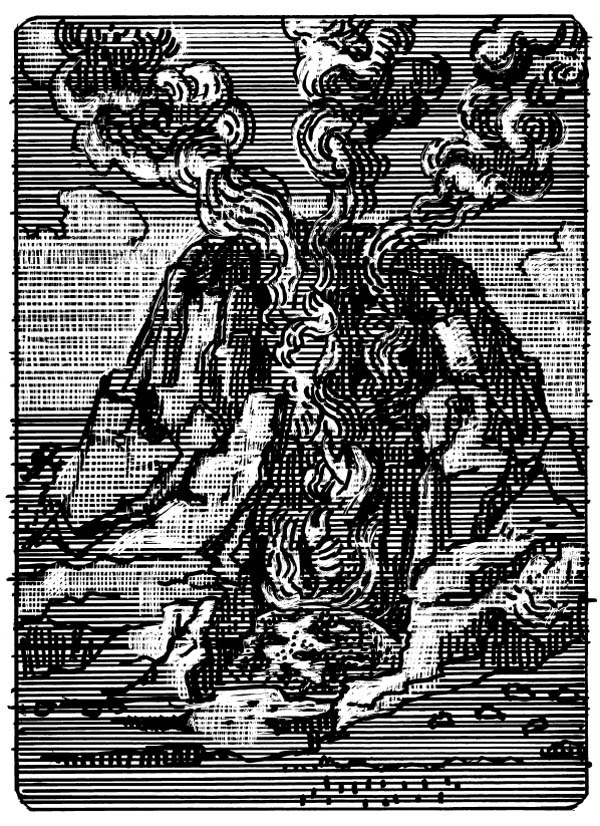
I always enjoy writing about comics from outside the United States. Sometimes, I am not sure how to hook into a work and I find it is better to let it simmer and then I come back to it. So is the case with “Läskimooses.” You can now enjoy an issue of the comic book with a handy translation sheet in English. That will certainly clear up any questions about why you’re seeing a bunch of monkeys or what’s going on regarding a volcanic eruption.
Page from Läskimooses #28
Again, let me emphasize that the visuals are pretty stunning all by themselves. Some issues, like #28 above, are only images, no text at all. Basically, all you need to know to begin with is that Läskimooses and Ohto are both planets and figure prominently in the narrative. The two ongoing characters have their own ideas on existential matters that they’re working through. It’s interesting that Hagelberg’s initial idea was to set his story on the Mars of Edgar Rice Burroughs. He had a spectacle in mind right from the start. Anyway, we’re all working through our own existential issues, right? It’s fun to see an artist with such an unabashed and audacious attitude share with us his vision of the sublime and the profound. I look forward to what develops next with this intriguing and unusual project.
To get an issue of “Läskimooses,” with an English translation sheet included, go to Printed Matter right here.
For a closer look at the artist at work, check out this video right here.
“Alien: Covenant” is a strong stand-alone film. If you knew nothing about the Alien franchise, we have here a set of characters worth getting to know and a plot that holds it own. This time around, it seems that the space inhabited by the crew has opened up a little more and there’s more light. It’s not by any means as perky as Star Trek but the crew feels a bit closer to each other. Everyone seems to trust each other with one exception: Walter, the ship’s android. He’s sort of like Spock but not quite enough.
Michael Fassbender
Michael Fassbender knocks out a devilishly good performance. Or, should I say, two performances. He is Walter, the ship’s android. And, later on, we see David, the “synthetic” crew member from “Prometheus” also played by Michael Fassbender. David, the lone survivor of the Prometheus, has what you can call some major AI problems: too smart for his own good, too idiosyncratic. And when was it ever a good idea for a robot to have too much independence?
Katherine Waterston
As for the newer version, Walter, he can think for himself but knows how to hold back. Bots are spooky to begin with so it’s no surprise that humans don’t warm up to him. However, there is one crew member who genuinely finds Walter to be good company. Daniels (played by Katherine Waterston) is a young woman who just lost her husband in a serious accident on board. Captain Oram (played by Billy Crudup) blames Walter with no real basis to do so. Then there’s Daniels who tries to comfort Walter, and herself, by confiding in him about the plans she had for building a real log cabin on the next space station they settle.
The dynamic of Fassbender, Waterston, and Crudup serve as our foundation. Let the Alien critters descend from wherever they please! You can expect Alien embryos to burst forth from all the bloody spots they usually like to emerge from. Katherine Waterston does a fine job of channeling her best Sigourney Weaver. Billy Crudup is a lot of fun as the captain without all the answers. But it’s Michael Fassbender who is this movie’s undisputed quarterback. If ever Ridley Scott’s more esoteric ruminations on existential matters had a more apt orator, it is, without a doubt, Michael Fassbender.
For more details on “Alien: Covenant,” visit Fox Movies right here and check out the Alien Universe right here.
Comics are a medium unlike any other as they merge visuals with the written word to tell a story. The closest form they have is film and television, but even then, they differ. Comic books are the masters of detail and controlling a reader’s movement. You can put in huge amounts of detail when necessary into a panel to convey information and a reader can look at this for as long as they like and take in as much as they desire. This doesn’t work in a novel, as it would have to be a long paragraph that would be boring to read and is tough to go over the details again and again. A movie can freeze on a screen but it can’t linger too long though. With a comic, however, you can take as much time with each panel as you think it needs and go back and forth with ease to things you may have missed. These are a comic book’s strengths.
Ever since the 1930s we have seen comics grow and grow as a medium. We’ve seen people try new ideas and formats in order to create fresh styles and concepts. Whether it’s monthly single issues, graphic novels, page a day webcomics or whatever, you can present them in different ways to further your story or hook a reader. Despite comics being popular entertainment for many years, they have never quite been as loved as their contemporaries. These characters and stories remain fashionable though and have a strong following, and this has allowed people to adapt them in new ways.
Superheroes are a great example of this. Today you can find many costumed heroes who fight villains in any form you can think of. You can go to the cinema right now and enjoy classic comic book characters and obscure ones, all with a big budget. This has brought comic heroes to a wider audience than ever. Most would know about Spider-Man, Superman, Wonder Woman, etc. but now Deadpool, Hawkeye, Black Panther, Cyborg and even Rocket Raccoon have become pop culture icons.
This isn’t the only form we’ve seen superhero style characters, as video games have also been able to successfully adapt them. Comic book style characters having amazing abilities, great villains and interesting locals and gimmicks makes them prime content to adapt for a game and this has been done in many ways. The Batman Arkham series have enabled people to immerse themselves in Batman’s world and fight like he does. Telltales’ Wolf Among Us puts you in more direct control of the cast of Fables and enables you to shape the story. Other games can be wild takes, such as Ladylucks’ Ghostbusters game. The Marvel vs. Capcom and Injustice games abandon the story of comic book characters and instead focus on their abilities and designs, taking a hyperactive and direct approach.
Comic books as a medium will likely be around forever in some form or another. They may find new popularity or become more obscure but it’s safe to say that the characters and stories they contain will be loved forever.
“The Fabulous Allan Carr,” directed by Jeffrey Schwarz
Warren Beatty announcing the wrong winner at this year’s Oscars was a disaster but the all-time biggest disaster is so bad that the Academy of Motion Picture Arts and Sciences would rather not discuss it and there is nothing on Youtube to document it, except for a verbal description by comedy writer Bruce Vilanch. The story is about how legendary Hollywood producer Allan Carr ended up creating the strangest opening number ever for the Oscars. That infamous moment, truly mind-bending surreal camp, is the linchpin to a new documentary on a fascinating life and career, “The Fabulous Allan Carr,” directed by Jeffrey Schwarz.
If you were a kid growing up in the ’70s, as one snarky person interviewed in the doc says, there were two big movie events: for straights it was “Star Wars” and, for gays, it was “Grease.” Be that as it may, “Grease,” back in 1978, was a very big deal at my high school, whatever your sexual orientation. I was in the marching band and, as a last-minute prank, many of the boys decided to drop their pants and moon the crowds in the stadium. This was directly inspired by “Grease,” which was as far away from an Oscar opening number flop as you could get. “Grease” was a bonafide hit and it put the movie’s producer, Allan Carr, on the map.
Steve Rubell losing patience escorting Olivia Newton-John and Producer Alan Carr into the “Grease” Party at Studio 54.
How Allan Carr gained the confidence and sense of purpose to become a Hollywood legend is thoroughly explored here. We follow Carr from insecure boy to insecure man, finally losing his virginity in his 30s. Where he was on firm ground was his steadfast desire to put on a show. If you loved “La La Land,” you will relate to Carr’s great love for the grandeur of Old Hollywood, particularly the heyday of movie musicals. After Carr’s success with “Grease,” there would be various ups and downs. One undisputed high point was his producing the Oscar-winning “The Deer Hunter.” And Carr reached his greatest heights producing “La Cage aux Folles” on Broadway.
And then came that incredibly over-the-top opener for the 1989 Oscars. The clip below is not from the documentary but gives you an understanding of what all the fuss was about. This is Bruce Vilanch who, by the way, does provide some wonderful segments exclusively made for the documentary:
EDITOR’S UPDATE: Okay, it turns out that the “infamous” 1989 Oscars opening segment is currently available on YouTube. And, like many a legend, there is more to this story. Basically, it helps to view the above segment with Bruce Vilanch along with seeing the actual footage. Vilanch makes a big mistake by adding to the legend with his hyperbolic description of the show. Despite that, he provides the necessary context. Most importantly, Vilanch explains that this was a case of “manufactured outrage” by Disney president Frank Wells, who lodged a complaint against the Academy even though Snow White is in the public domain. The truth is, Disney was hypersensitive about advertising concerns. Here is the clip. You will likely find this to be charming, entertaining, and heartfelt:
After “Grease” would come Carr’s first big misstep: 1980’s “Can’t Stop the Music,” the musical showcasing The Village People. Carr had hoped to bring abroad Olivia Newton-John for a lead role but, after reading the script, she rejected it. So did Cher and Raquel Welch. However, Carr was able to secure Valerie Perrine. Carr also enlisted a rising star, Steve Guttenberg. The whole affair was directed by veteran funny lady Nancy Walker who was not much of a director. In the end, this was a classic Carr flop: over-sexed camp too far out on a limb. And so he moved on to the next project, and the next.
In time, Carr would find himself. One key personal moment was when he discovered caftans. The spacious velvety robe allowed Carr’s undisciplined body to run free. With a caftan, he could relax and be more open about himself and his sexuality. The ups and downs of his projects would settle into perspective. There would be the undisputed triumphs. And, in the end, he could say he lived his life to the fullest.
“The Fabulous Allan Carr,” directed by Jeffrey Schwarz, was a standout at this year’s Seattle International Film Festival. The documentary is based upon the book, “Party Animals: A Hollywood Tale of Sex, Drugs, and Rock ‘n’ Roll Starring the Fabulous Allan Carr” by Robert Hofler. As the story about a gay chubby insecure boy who grows up to live out his wildest dreams, it provides another compelling view of the hopes and dreams of La La Land.
For a sampling of some of the best independent cartoonists today, one great source is the NOT MY SMALL DIARY anthology, edited by Delaine Derry Green. Cartoonist John Porcellino, known for his “King Cat” comics, has called Delaine’s anthology, “One of the most important comic-zines in history.” Here is a look at Issue 19: Unexplained Events, which showcases the work from 43 talented artists.
Panel excerpt from Kevin Van Hyning’s “The Curse of Macbeth”
So, the theme of “unexplained events” leaves open a wide field of opportunities from things that go bump in the night and beyond. One of the most inventive, jarring, and downright entertaining pieces comes from Kevin Van Hyning. It’s a pretty messed up misadventure and I hope and pray that nothing close to this actually happened to Kevin. Like a lot of creative people, myself included, Kevin has many outlets, like performing on stage. In “The Curse of Macbeth,” we see what can happen when an actor confronts the age-old superstition of daring to say “Macbeth” before a show. It’s supposed to be very bad luck! And, as it turns out in this comic, it’s the sort of bad luck that can knock your teeth out! Inspired work! A big takeaway for me is learning of this curse as I don’t believe I’d ever heard of it before. But it has a long tradition dating back to the very first time it was performed in 1606. Teeth kept being knocked out and worse!
David Lasky’s “Mothman”
As a cartoonist myself, who has observed and commented upon the comics scene for many years, I am delighted to see page after page of inspired work from familiar and new talent. What you find in this book is a treasure trove of comics experimentation. Each creator is working within their own special confines, powered by their own personal engine. This is a fascinating book and a must-read for anyone interested in contemporary comics. Each artist you visit here is like a little island onto itself. We paddle ashore and reach the Isle of David Lasky. Here we find enigmatic work giving out a melancholic howl. In the one-page “Mothman,” we find the distinctive Lasky poetic comic. Relax your shoulders and linger over it.
Panel excerpt from “My ‘Unsual’ Sighting’ by James Burns
The universal symbol for the unexplained seems to always go back to UFOs. And so I close with a piece by James Burns, “My ‘Unusual’ Sighting.” The most eerie and creepy incidents are beautifully underscored by the mundane. Often the most profound things must compete with the most banal and so it is in this comic. It is 1966 and a bunch of kids innocently look up in the sky and seem to be watching their favorite sci-fi show in the clouds–but they’re not. Or what are they seeing? Ten years later, Burns is eighteen and has an opportunity to possibly confirm his most wildest speculation. But he’s still a kid–and what is he supposed to do if his suspicions are correct? Nicely done and a fitting example to a most impressive collection of work in comics.
Be sure to keep up with Not My Small Diary at Delaine Derry Green’s My Small Web Page right here.
It’s that touch of strange that the best writers and artists tap into that makes all the difference. Writer Steve Niles says that his already odd story took some more twists and turns after he viewed what artist Alison Sampson had done with the first issue of their new limited-run comic book series, WINNEBAGO GRAVEYARD. Soon, you’ll be able to see the results for yourself. This is an advance review so a word to the wise (comic book retailers stock up!) and mark your calendar for this Image Comics release on June 14th.
Isn’t it spooky when you thought you saw something out of the corner of your eye? That particularly creepy feeling, the mixing of the banal with the terrifying, keeps building in this first issue in a most satisfying way. We begin in the small American Southwestern town of Acton, one minute after midnight. There’s an orgy of violence with a Satanic ceremony that climaxes with the emergence of a portly and banal naked man declaring his return from the dead. Who is this portly banal man? All we know is that he stepped right out of the body of one of that night’s victims to sacrifice.
This disturbing uneven feeling of disconnection and terror is quite pleasing, and the credit all goes to the team of writer Steve Niles and artist Alison Sampson. With dynamic and moody colors by Stéphane Paitreau. And lyrically placed lettering by Aditya Bidikar. Our story seamlessly rolls along a nightmarish landscape with characters nearly oblivious to what’s going on. It’s more of that delicious disconnection at play.
Winnebago Graveyard!
For, you see, the Winnebago from this comic’s title symbolizes a slice of normal that gets caught in this big fat wedge of crazy. It’s your all-American family, full of equal amounts of wanderlust and dysfunction, that find themselves way off course, all too close to Satan’s country. But are they aware of what’s going on? Sampson depicts them as utterly disconnected in such a masterful way. After spending a whole day in what amounts to an abandoned amusement park, they seem to be getting a clue that they’re very much out of their element. For now, it all seems like a sleepy nightmare.
I was mesmerized by Sampson’s artwork in GENESIS, a one-shot with Image Comics, and wrote a review of that you can read here. This latest comic lives up to what I expected to see next in her work. This is a smashing first issue. You will also want to check out the two essays at the end of this comic. One is on horror movies set in the American Southwest by Sarah Horrocks and it focuses on the 1987 horror classic, “Near Dark.” The other essay is about Satanism in the real world by Casey Gilly and it focuses on Anton LaVey’s Church of Satan and the potential motivations of its followers.
Both essays are part of a series that will run throughout all four issues. I am so glad to see these essays, which compliment the comic and, in fact, become part of the comic. As I like to point out to my readers, we do not live by comics alone. I make a point of writing about all sorts of things and they usually have a relationship to comics, even a quite meaningful connection, like my in-depth interview with novelist Jerome Charyn. Maybe I do things a little differently here but I’m not changing and I believe my readers appreciate that.
And let’s hold on just a bit. Yes, I would take issue with anyone who thinks a discussion about comics takes place in a vacuum. I don’t think anyone really believes that since, even the most so-called comics purist will veer off being strictly on topic. Life, the culture-at-large, bigger and brighter things, exist out there in the world. So, again, I say that the isolated prose, the two essays, in this comic becomes part of the comic. Gilly, in her essay, even directly refers back to the comic and asks the reader to question what the character Chrissie was really seeing. And Horrocks, in her essay, riffs so smoothly on the desert motif running throughout the comic. What a literate and artful comic! Buy it!
WINNEBAGO GRAVEYARD #1 (Of 4) is published by Image Comics and is available as of June 14, 2017. For more details, visit Image Comics right here.
I really appreciate the insightful review by Stacey E. Bryan of my graphic novel, “Alice in New York.” Stacey is the author of the humorous supernatural thriller, “Day for Night.” Her review is a wonderful boost of acknowledgement. All of us writers and artists strive for just this sort of connection.
The Big Apple. For a lot of people, those four words would mean little or nothing. But for me personally, it means a lot, because I was living there in 1989. The Twin Towers were still intact. Our country hadn’t turned that strange corner yet and started accelerating down a slippery slope into the 24-7 fear-mongering which has left us in the mess we’re in today.
When you’re in a mess, there’s no room for magic. But in 1989, in New York City, the old gods, the old ways, were still intact, and this is the year and the setting where Henry Chamberlain captured that feeling tenderly and bravely with his graphic novel “Alice in New York.” […]